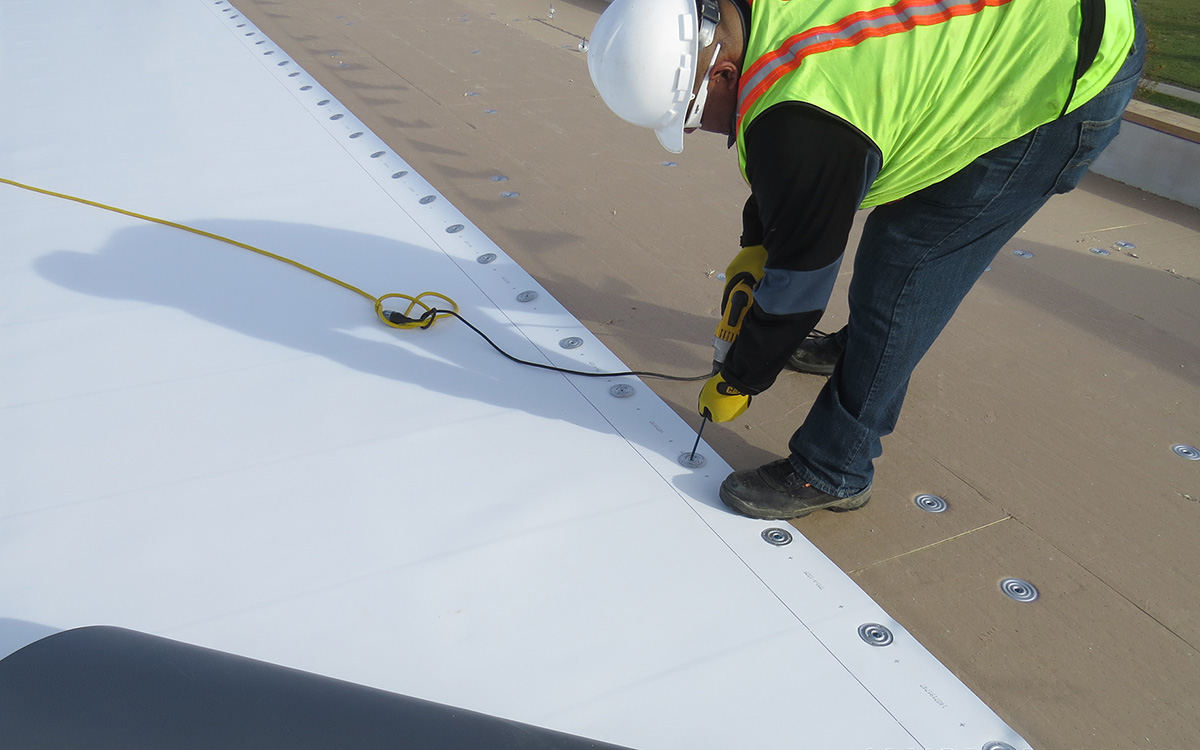
TPO Single-Ply Roofing
TPO — thermoplastic polyolefin — is the dominant new-construction and replacement roofing membrane across Tacoma's commercial and industrial market, and for straightforward reasons: it heat-welds reliably, it is compatible with the full range of insulation and recovery board systems, it carries manufacturer warranty programs with competitive terms, and it performs well in the Pacific Northwest's cool-wet climate. Frederickson Industrial Center new construction, Tideflats warehouse re-roofing, and the commercial and institutional buildings along the SR-167 logistics corridor are all places where TPO is the default specification that gets evaluated first and replaced by a different system only when a specific performance requirement — chemical resistance, extreme UV demand, or mechanical complexity — pushes toward PVC, KEE, or a modified bitumen alternative.
The energy argument for white reflective TPO carries less weight in Tacoma than the roofing industry's national marketing suggests. Cool roofing rebates and reflectivity-focused specifications were developed in cooling-dominated southern markets where reducing peak cooling loads is a meaningful energy cost driver. Tacoma averages fewer than two days above 90°F annually and runs a heating-dominated energy balance for the overwhelming majority of the year. A white TPO roof reduces a cooling load that barely exists while providing no meaningful benefit during the heating season — in fact, a black or dark membrane would absorb marginally more solar heat in winter. The correct argument for white TPO in Tacoma is seam quality and UV stability over Pacific Northwest wet seasons, not reflective energy savings.
Seam quality is the defining performance variable for TPO in Tacoma's sustained-rain climate. Hot-air welded TPO seams, executed at proper temperature with verified weld width and probe-tested after cooling, create a fusion bond across the full lap width that is as strong as the membrane field. Those seams can be subjected to months of continuous moisture — October through April without significant dry-out periods — and remain watertight because the weld is the membrane material itself, not an adhesive layer subject to delamination. The roofing contractor executing a TPO project in Tacoma must be able to maintain consistent weld quality across the temperature and humidity range that fall and spring installation seasons deliver, and that requires proper welder calibration, experienced operators, and daily weld testing protocols.
Frederickson Industrial Center and Tideflats new construction accounts for a substantial volume of TPO installation in Pierce County each year. Large-format warehouse and manufacturing buildings on these sites are straightforward TPO applications: mechanically attached 60-mil membrane over polyisocyanurate insulation over steel deck, with heat-welded seams and standard HVAC curb flashings. The scale of these projects — routinely 100,000 to 300,000 square feet on a single building — means that seam length is measured in miles and fastener count is measured in thousands. Quality control at that scale requires systematic weld testing, not spot-checking, and fastener pull-out testing to verify the attachment pattern is meeting the wind uplift design requirements for the specific building location.
Fully adhered TPO is the specification for occupied commercial buildings in the Tacoma Dome District and transit-adjacent locations where the noise and vibration of mechanical fastener installation would create tenant complaints, or where the aesthetic requirement is a smooth membrane surface without the slight undulation that mechanically attached systems develop between fastener rows. Fully adhered systems require a compatible substrate — typically polyisocyanurate or glass-faced cover board — and a bonding adhesive applied and allowed to flash off before the membrane is rolled into the adhesive. In Tacoma's cool shoulder seasons, adhesive flash-off time extends and must be managed by the applicator to prevent adhesive transfer problems that reduce bond strength.
TPO UV stability in the Pacific Northwest wet season is a legitimate performance consideration, separate from the reflectivity argument. TPO membranes contain antioxidant packages that protect the polymer from UV-induced oxidation, and these packages deplete over the membrane's service life. In Tacoma's overcast climate, the UV dose delivered to a roof membrane per year is lower than in high-UV markets, which means the antioxidant depletion rate is slower and the UV-driven end-of-life timeline is extended. A 60-mil TPO membrane specified with a 20-year NDL warranty in Tacoma is a conservative specification with meaningful service life margin remaining at warranty expiration.
TPO seam failures — the primary failure mode we see on aged or improperly installed TPO roofs in Tacoma — manifest as lap edge lifting, most commonly at T-joint intersections where three membrane layers meet and the weld geometry is most complex. T-joints require hand welding with a silicone roller to consolidate the extra membrane thickness at the junction — a step that is sometimes rushed or omitted by less experienced crews. We probe every T-joint on every TPO roof we inspect, because those are the locations most likely to show incipient failure before the open lap becomes an active leak. On new installation, we photograph and probe every T-joint as a quality control record.
TPO compatibility with rooftop equipment — condensate from HVAC equipment, cooking grease from exhaust fans, petroleum-based maintenance products — is a consideration on commercial buildings where rooftop activity is high. Standard TPO is not chemical resistant in the way that PVC and KEE are, and repeated grease or solvent contact on the membrane surface will degrade the polymer over time in the contact zone. On buildings with confirmed grease exhaust — restaurant exhaust fans, food processing make-up air systems — we specify PVC or KEE at the membrane zone below the exhaust discharge and transition to TPO for the balance of the field, rather than specifying the more expensive chemical-resistant system across the full roof area.
Roof Questions
How thick should TPO be on a Tacoma commercial building?
45-mil TPO is the code minimum but is not a specification we recommend for new commercial roofing in Tacoma. 60-mil is the appropriate standard for commercial and industrial buildings — it provides adequate membrane thickness at the weld zone, better puncture resistance under rooftop foot traffic, and qualifies for 20-year NDL manufacturer warranties. 80-mil is appropriate for buildings with heavy rooftop equipment access or where the owner requires the longest available warranty term.
What warranty is available on TPO roofing in Tacoma?
Major TPO manufacturers — Carlisle, Firestone, Versico, GAF — offer manufacturer-backed warranties from 10 to 25 years depending on membrane thickness and warranty level selected. No Dollar Limit (NDL) warranties cover both material and labor for the full warranty period and require installation by a certified applicator plus a manufacturer field inspection at project completion. We carry current certifications for the TPO systems we install and handle warranty registration at project closeout.
Is TPO or EPDM better for a Pacific Northwest building?
Both perform well in the Pacific Northwest climate — the correct choice depends on building-specific factors. TPO offers heat-weldable seams, white reflective surface, and better chemical resistance than EPDM. EPDM offers a longer track record on Pacific Northwest buildings, excellent cold-temperature flexibility, and is often lower in material cost. On buildings without chemical resistance requirements, either system is a sound specification. On buildings with chemical exposure considerations, TPO or PVC is the more appropriate path over EPDM.
Can TPO be installed in the fall in Tacoma?
Yes, with appropriate weather management. TPO can be mechanically attached and heat-welded in cool temperatures — the welder temperature settings are adjusted for ambient conditions to maintain consistent weld quality. The constraints are wet substrates, which prevent proper adhesive application for fully adhered systems, and sub-freezing temperatures, which affect membrane flexibility and handling. We schedule TPO installation with daily weather monitoring and close open work areas with temporary protection before any rain event.
My TPO roof is 12 years old. What maintenance does it need?
At 12 years, a TPO roof in Tacoma should receive a systematic inspection with seam probing, penetration flashing assessment, and drain clearing if not already on a maintenance program. The membrane field is likely in good condition at this age in the Pacific Northwest's moderate UV environment. Attention should focus on T-joint integrity, curb flashing terminations, pipe boot condition, and edge metal. Any open seam conditions found at this age should be repaired promptly — a seam that is 40% delaminated at year 12 will be fully open by year 15.