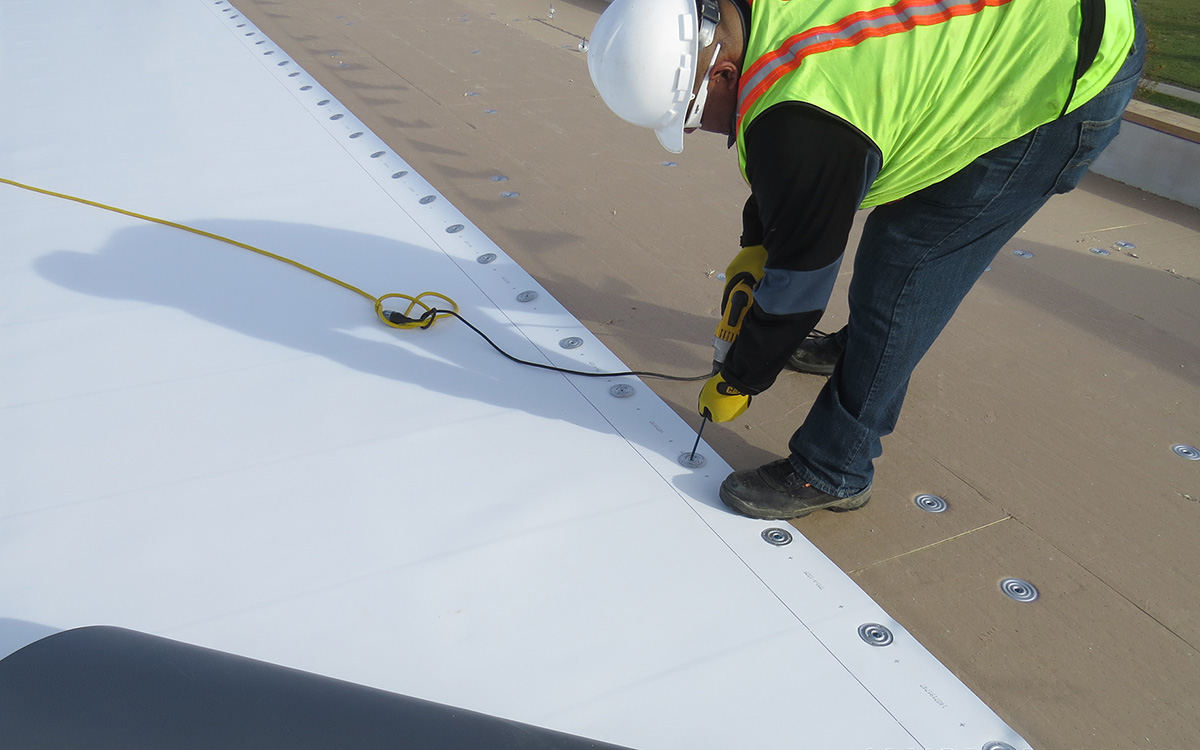
PVC Roofing
PVC Roofing is the chemical-resistance workhorse of Tacoma's industrial roofing market — the system specified when building use involves food processing, chemical storage, pharmaceutical manufacturing, or any operation where rooftop exhaust or surface contamination would degrade a standard membrane. In the Tideflats industrial corridor, the Frederickson Industrial Center, and along the Port manufacturing facilities, PVC has been the system of choice for food and chemical applications for decades. The membrane's resistance to a broad range of oils, fats, acids, and industrial solvents makes it the appropriate baseline specification before KEE is considered for the most aggressive chemical environments.
PVC's chemical resistance comes from its formulation — the vinyl chloride polymer matrix is inherently resistant to many common industrial compounds. The critical caveat is plasticizer migration: PVC membranes contain plasticizers that maintain flexibility, and certain solvents and oils can extract those plasticizers from the membrane over time, causing the membrane to stiffen and eventually crack. On Tideflats buildings where chemical exhaust is a direct, continuous contact condition — not just incidental splash exposure — we evaluate the specific chemistry against PVC's resistance profile before confirming the specification. When plasticizer migration is a confirmed risk, KEE is the upgrade path.
Heat-welded PVC seams are the defining quality advantage of PVC over adhesive-bonded systems in Tacoma's sustained-wet climate. The hot-air welding process fuses the two membrane surfaces into a single continuous layer at the lap — the seam bond is the membrane material itself, not an adhesive layer. When a probe test is performed on a properly welded PVC seam, the probe skims across a monolithic surface with no adhesive interface to delaminate. On Tacoma buildings that see months of continuous moisture, wind-driven rain, and thermal cycling between October and April, that fusion bond reliability is the reason PVC has maintained its specification position despite competition from newer single-ply systems.
Pacific Northwest installation conditions do affect PVC welding quality in one specific way: cold temperatures reduce the membrane's flexibility and can make it more difficult to achieve consistent weld quality at the lap edge if the membrane is not allowed to warm before welding. PVC becomes stiffer below 40°F, and laps that are not properly relaxed before welding can have micro-voids at the seam edge that allow water entry. We use membrane warming protocols — unrolling sheets and allowing them to acclimate to ambient temperature before welding, using heated tents on very cold mornings, and adjusting welder temperature settings for ambient conditions — to maintain weld quality across Tacoma's cool shoulder seasons.
New construction on Frederickson Industrial Center and Tideflats sites that involves food processing or chemical manufacturing almost universally specifies PVC. The new building's mechanical design includes rooftop exhaust systems from day one, and the roofing specification follows the exhaust chemistry rather than defaulting to the most common system in the market. We work with mechanical engineers and building owners during the design phase on these projects to confirm that the specified PVC product's resistance profile matches the specific compounds the building will process, and that the membrane thickness — typically 60 or 80 mil on industrial applications — is appropriate for the projected service life and foot-traffic level on the roof.
PVC Roofing in Tacoma's cool, overcast climate loses some of its conventional energy argument. The white reflective surface that reduces cooling loads in Phoenix or Houston provides a more modest benefit in a city that averages fewer than two days above 90°F per year. The energy case for PVC in Tacoma is therefore weaker than the chemical resistance and seam performance case, and we present it that way. Building owners making a system decision between PVC and TPO on a building without chemical resistance requirements should understand that the energy performance difference is marginal in this climate and that other factors — seam quality, warranty terms, contractor familiarity, and cost — are the more meaningful differentiators.
PVC over metal deck on Frederickson industrial new construction follows standard mechanically attached or fully adhered installation depending on wind uplift requirements. Pierce County's design wind speed and local exposure category determine the required fastener pattern for mechanically attached systems. On buildings near the Tacoma Narrows and exposed waterfront locations, uplift requirements are higher than for sheltered inland sites, and we design the fastener layout accordingly. Fully adhered PVC provides superior uplift resistance and eliminates the billowing that can occur with mechanically attached single-ply in high-wind conditions, but it requires a smooth, clean substrate and proper adhesive temperature conditions during application.
End-of-life PVC on older Tideflats and Frederickson buildings — systems installed in the early 1990s that are now 30 or more years old — often shows plasticizer depletion even without chemical exposure, because PVC's plasticizers migrate slowly over decades even under normal weathering. A 30-year-old PVC membrane that has stiffened and shows surface cracking is at end of life regardless of its exposure history. Replacement with new 60 or 80 mil PVC, or a transition to TPO or KEE depending on current building use, is the appropriate path. We do not attempt to coat or recover severely plasticizer-depleted PVC — the substrate condition makes adhesion unreliable and the coated result is not a lasting solution.
Roof Questions
Is PVC or TPO better for a Tacoma food processing facility?
For buildings with confirmed cooking oil, animal fat, or food-processing chemical exhaust contact with the roof membrane, PVC is the more appropriate specification — its resistance to lipid-based compounds is better documented than TPO's. For buildings without direct chemical contact — a food distribution warehouse with no processing exhaust — TPO is a viable alternative and typically carries a lower material cost. We evaluate the specific building use before recommending one over the other.
How thick should PVC Roofing membrane be on an industrial Tacoma building?
50-mil PVC is the minimum for commercial applications. 60-mil is the standard specification for industrial buildings with moderate foot traffic and normal exposure conditions. 80-mil is appropriate for buildings with heavy rooftop equipment access, chemical exposure environments, or where the owner requires a 20-year NDL warranty. Thicker membranes are more resistant to puncture from rooftop traffic and provide additional material reserve for the seam welds.
Can PVC Roofing be installed over an existing membrane?
Yes, on a recover scope with recovery board, if the existing insulation is dry and the existing substrate is structurally sound. PVC cannot be installed directly over EPDM or bituminous surfaces without a separation layer — the plasticizers in PVC are incompatible with bitumen and the contact will cause migration failure. Recovery board provides the required separation and a fresh substrate for the PVC adhesion or mechanical attachment.
Why is my PVC roof cracking even though it is only 20 years old?
Plasticizer depletion is the most common cause of premature PVC cracking — certain solvent exposures, prolonged ponding of incompatible liquids, or in some cases accelerated weathering can draw plasticizers from the membrane faster than normal aging. If the cracking is localized below rooftop exhaust equipment, chemical exposure is the likely cause. If it is general across the field membrane, accelerated plasticizer migration from weathering or a thin original membrane may be the factor. Either condition warrants a replacement evaluation.
Does PVC Roofing come with a manufacturer warranty in Tacoma?
Yes. Major PVC manufacturers — Sika Sarnafil, Carlisle, Versico — offer manufacturer-backed warranties including NDL options on installed PVC systems. Warranty terms require installation by a certified applicator, minimum membrane thickness, and a manufacturer inspection at project completion. We carry current certifications for the PVC systems we install and process warranty registrations at project closeout.