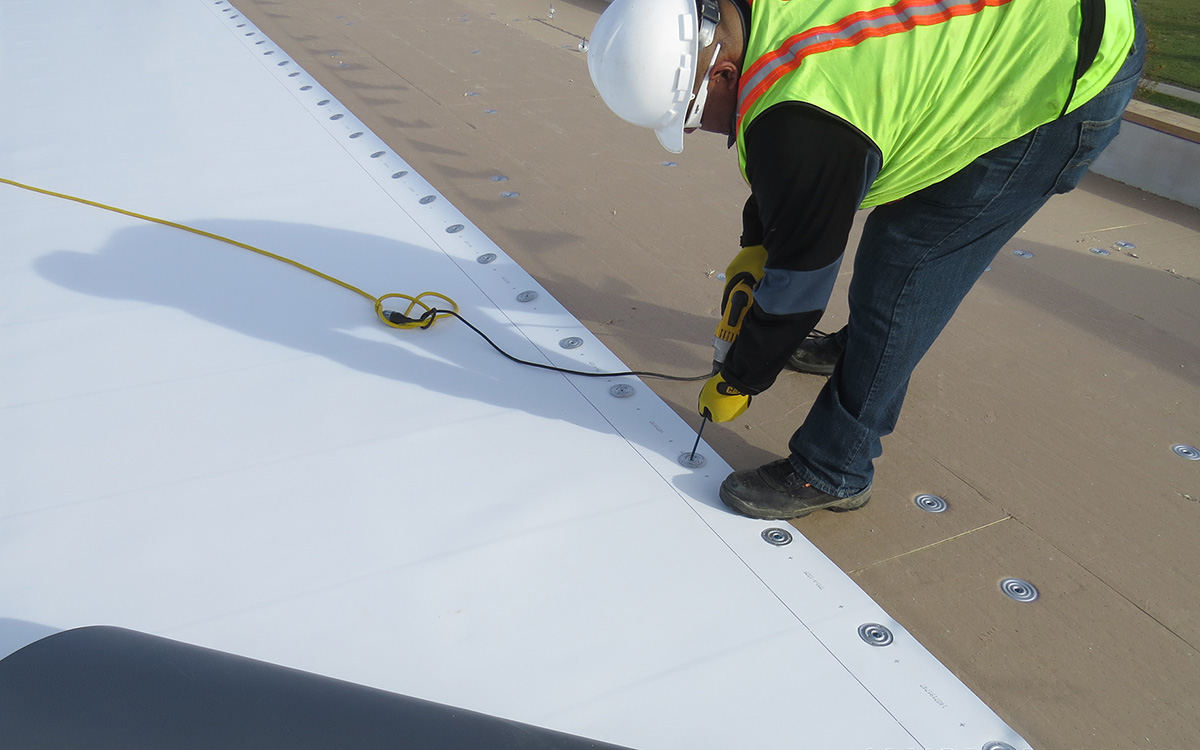
Commercial Roof Leak Repair
November is the month that tests every commercial roof in Tacoma. With 7.18 inches of average precipitation concentrated into sustained, low-intensity events that can run for days without a break, any defect in a membrane — a lifted lap seam, a failed curb flashing, a corroded fastener — becomes an active leak within hours of the first major storm. Our phones reflect that reality: emergency leak calls spike in the first two weeks of November every year, and the pattern repeats through January, which delivers another 6.06 inches. If your roof is going to fail, it will tell you in those three months.
The challenge with emergency leak repair in Tacoma's industrial corridors is access. Port of Tacoma logistics facilities and Frederickson Industrial Center warehouses were built for freight movement, not roofing contractor mobilization. Dock approaches are occupied by truck queues during operating hours. Rail-served buildings on the Tideflats have active rail access on one or more sides that cannot be blocked. Crane pads and laydown yards adjoin building perimeters. Getting a ladder truck or a man-lift into position for emergency roof access on these buildings requires coordination with facility operations that takes time — time that interior equipment and inventory cannot afford during an active water intrusion event.
We manage that access challenge by having the pre-access conversation before the emergency happens. For industrial and port facilities that are in our maintenance program, we have current site access contacts, know the dock schedule, and understand where equipment can stage. When the call comes at 6 AM on a Wednesday in November, we are not starting from zero on access logistics. For facilities that are not in a maintenance program, emergency response time is longer because we are solving the access puzzle and the leak simultaneously.
Locating the actual entry point of a commercial roof leak is diagnostic work that cannot be rushed. Water that enters at a failed lap seam on the west slope of a warehouse can travel 30 to 40 feet along a roof deck steel flute before it drops through a fastener hole onto an interior ceiling. The bucket is never directly under the entry point. We trace leaks by examining interior ceiling staining patterns, correlating with roof slope and drainage direction, and then walking the roof surface in the vicinity of the suspected entry zone — probing seams, checking flashings, and looking for fresh debris displacement that indicates a recent disturbance.
On Downtown Tacoma buildings — the historic masonry commercial blocks on Pacific Avenue and the mixed-use structures near the Stadium District — leak sources are often at the wall-to-roof transition rather than in the field membrane. Parapet base flashings that have separated from the masonry, coping cap joints that have opened, or through-wall scuppers that have lost their counterflashing allow water to enter above the roof level and travel down the interior of the wall before appearing as a ceiling drip. Distinguishing a roof leak from a wall leak is essential before any repair work begins — misidentifying the source leads to unnecessary roof repairs that do not stop the interior water entry.
JBLM contractor buildings in Lakewood and Spanaway present both access coordination requirements and, sometimes, building-specific constraints on repair materials. Certain facility leases specify approved contractors or approved material systems. We verify material requirements with the facility manager before mobilizing repairs to avoid a situation where an emergency repair must be redone because the material used was not on the approved list.
Temporary emergency dry-in is sometimes the right first step when conditions prevent a permanent repair — active rain on an open membrane, for example, or a damage area that requires structural assessment before a permanent system can be applied. We carry tarping and temporary sealant materials for emergency containment, and we are explicit with building owners about what constitutes a temporary fix versus a permanent repair so there is no ambiguity about what follow-up work is required.
After every emergency repair, we provide a written summary of the entry point found, the repair executed, the materials used, and any additional deficiencies observed during our time on the roof. That document serves as the baseline for the owner's maintenance record and, when relevant, as supporting documentation for an insurance claim. A leak that caused interior damage in November with a documented repair record is a cleaner insurance conversation than a leak with no documentation of cause or remedy.
Roof Questions
How quickly can you respond to an emergency roof leak in Tacoma?
For buildings already in our service program, same-day response is standard for calls received before noon during the week, and we maintain emergency contact availability on weekends during the November through January peak season. For new clients, response time depends on crew availability and access logistics. We are honest about timeline when we take the call — a building with constrained dock access or security protocols may require several hours to mobilize correctly even when crews are available.
My building is leaking in multiple spots — where do you start?
We triage by interior damage risk first — active water near electrical panels, server rooms, or production equipment gets addressed before water dripping into open warehouse space. On the roof, we prioritize finding and sealing entry points with the highest volume of water intrusion. In many cases, multiple interior drips trace back to a single roof-level failure, so methodical diagnosis before patching is essential to avoid wasted labor on the wrong locations.
Is a roof leak repair covered by commercial property insurance?
Coverage depends on the cause. Sudden damage from a wind event or falling object is typically covered. Gradual deterioration from deferred maintenance is typically excluded. We document the physical evidence at the point of failure — membrane condition, flashing integrity, fastener condition — and note any indicators of sudden versus gradual failure. That documentation is what your adjuster needs to evaluate the claim. We are not insurance adjusters, but we provide the field evidence clearly.
Can you repair a roof leak while it is raining?
Some repairs can be executed in light rain — removing standing water from a drain area, applying emergency sealant to an open seam, or repositioning a displaced flashing. Permanent membrane repairs and adhesive-bonded patches require a dry, clean substrate for proper adhesion. When conditions do not allow permanent repair, we execute a temporary dry-in to stop active water entry and schedule the permanent repair for the next dry weather window.
After a leak repair, how do I know the leak is actually fixed?
We flood-test repaired areas when the scope and roof configuration allow — contain water over the repair zone for a minimum of four hours and monitor the interior for any continued intrusion. On large industrial roofs where flood testing the full perimeter is impractical, we use a low-voltage electronic leak detection method that identifies membrane breaches without water. We do not consider a repair complete until we have verified the seal, not just applied the material.