Commercial Roof Repair
Commercial Roof Repair in Tacoma is heavily driven by the intersection of marine air exposure and the city's sustained Pacific Northwest rain. The failure modes we see most often — open lap seams, corroded edge metal, deteriorated curb flashings, and drain area membrane splits — all share a common thread: water finds its way in through a system component that has been weakened by years of salt-laden air, UV cycling, and the mechanical stress of thermal movement. Repair work here is never just slapping sealant on a problem. It requires identifying why the component failed and addressing the root cause so the repair holds.
Edge metal and coping failures are among the most frequent repair calls we receive from Tideflats and Port-adjacent buildings. Galvanized steel gravel stops, aluminum drip edges, and painted steel copings all corrode faster within the marine influence zone that extends from Commencement Bay and the Thea Foss Waterway inland through the Tideflats manufacturing corridor. A gravel stop that would hold 25 years in the Frederickson industrial area may show rust-through perforations at the flange within 15 years on a building directly facing the waterway. When we repair these conditions, we specify stainless steel fasteners and use non-ferrous or coated metal where the original galvanized steel has failed — replicating the failed material is not a solution.
Curb flashing repairs around HVAC equipment are a constant in Tacoma's industrial and commercial building stock. Every rooftop unit, exhaust fan, and make-up air unit sits on a curb that requires a continuous watertight flashing termination. Those terminations are subjected to mechanical vibration from the equipment above, thermal movement as the curb and membrane cycle through temperature changes, and the continuous moisture load that a Tacoma fall-winter season delivers. We see curb flashing separations, open corner seams, and deteriorated membrane-to-counter flashing terminations on buildings of all ages. Repair requires removing the equipment in some cases or working around active mechanical systems — we coordinate with building mechanical contractors when equipment must be shut down or moved.
Drain area repairs address one of the highest-consequence failure zones on any flat or low-slope commercial roof. The membrane at and around a drain is under constant water load, and drain clamping rings can loosen over time, allowing water to bypass the drain flange and enter the roof assembly. We pull drain clamping rings, clean the drain flange area, replace the membrane if it has deteriorated in the sump, and reinstall the clamping ring with new hardware. On Tideflats warehouse roofs where drains are oversized for the original design rainfall and have since proven undersized for actual storm events, we evaluate whether drain enlargement or the addition of overflow scuppers is warranted alongside the membrane repair.
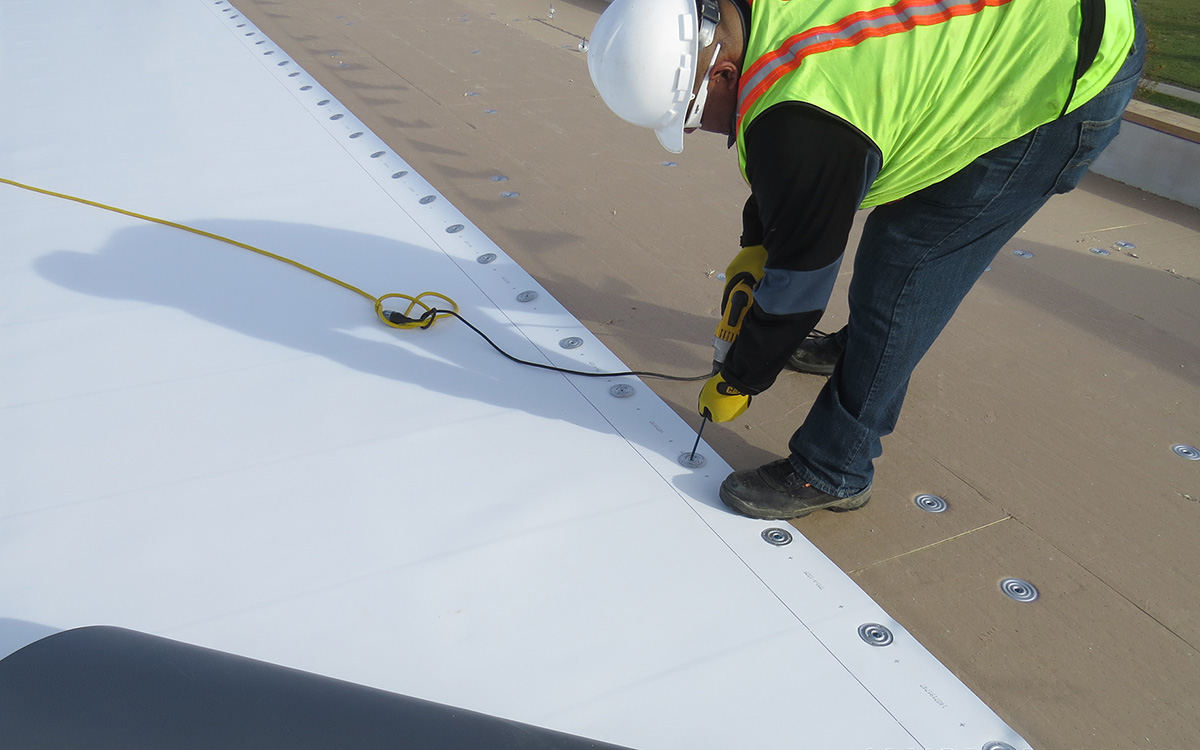
Lap seam repairs on single-ply membranes — TPO, PVC, and EPDM — require cleaning, preparation, and appropriate adhesive or heat-welding depending on the membrane type. TPO and PVC lap repairs can be heat-welded if the membrane is in sound condition adjacent to the open seam; EPDM requires contact adhesive and lap sealant. We test seam repairs with a probe tool after curing to confirm adhesion across the full repaired width. A seam that passes a probe test will hold in the wind-driven rain conditions that Tacoma's marine storms generate. A seam that was wiped with lap caulk and called complete will open in the first hard wind event.
Historic buildings in Downtown Tacoma, the Stadium District, and along Pacific Avenue often have repair needs that extend beyond the membrane to the masonry parapet and through-wall conditions. Water entry at a historic building is frequently the combined result of a roof membrane deficiency and a deteriorated masonry condition above the roof level. We work with masonry contractors when repairs require both roof membrane work and tuckpointing or parapet reconstruction — providing a coordinated scope prevents the situation where a roofing repair is undermined by ongoing masonry water entry that was never addressed.
For South Tacoma and Hilltop commercial buildings — the neighborhood retail and light industrial stock that lines Pacific Avenue and South Tacoma Way — repair budgets are often constrained and owners need to prioritize. We organize repair findings into tiers: what must be addressed immediately to prevent active interior water damage, what should be addressed within 90 days before the next rain season, and what can be monitored through the next inspection cycle. That prioritization framework lets a property owner make an informed decision about where their repair dollars go first.
Every repair we execute is documented with before-and-after photographs and a written description of the repair method and materials. That documentation serves multiple purposes: it gives the building owner a maintenance record, supports insurance claims when relevant, and provides the baseline for the next inspection visit so we can verify the repair is holding and has not created an adjacent stress concentration in the membrane.
Roof Questions
How long does a Commercial Roof Repair typically last?
A repair executed with proper surface preparation, compatible materials, and correct technique should match or outlast the surrounding membrane — often 10 to 15 years on a mid-life system. The caveat is that a repair does not reset the age of the system around it. If the membrane surrounding a repaired area is also near end of life, additional repairs will follow. We are candid about when the repair-versus-replace calculus tips toward replacement.
Why does my Tideflats building need edge metal replaced so much more often than my other properties?
Marine air from Commencement Bay carries salt moisture that accelerates galvanic and oxidative corrosion on edge metal, fasteners, and any ferrous component exposed at the roofline. Buildings within a half-mile of the waterway typically see edge metal service life that is 30 to 50 percent shorter than identical buildings in inland Pierce County locations. Specifying stainless steel fasteners and using factory-coated or non-ferrous edge metal materials extends replacement intervals significantly.
Can a curb flashing be repaired without removing the HVAC unit?
In many cases, yes. Standard curb flashing repairs — re-terminating the membrane at the counter flashing, sealing open corners, or replacing a deteriorated base flashing — can be performed with the unit in place if there is adequate working clearance around the curb perimeter. When a unit must be slid or lifted to access the full curb, we coordinate with a mechanical contractor and schedule the combined scope to minimize equipment downtime.
Is seam repair on TPO or PVC roofing permanent or temporary?
A properly heat-welded seam repair on TPO or PVC membrane creates a fusion bond that is as strong as the factory seam — it is a permanent repair, not a temporary patch. The key word is "properly": the repair zone must be clean, dry, and at the correct temperature for welding. A repair done in cold, damp conditions with an under-temped welder is a temporary fix regardless of what the installer claims.
My roof is 18 years old. Is it worth repairing or should I replace it?
Age alone does not determine whether repair or replacement is the right answer — system type, maintenance history, insulation condition, and the extent of the current damage all factor in. We run an infrared scan on any roof over 15 years where we are recommending a significant repair investment, because wet insulation changes the calculation entirely. A 20-year-old roof with dry insulation and isolated membrane damage is a candidate for continued repair; the same roof with 30% wet insulation is a replacement.