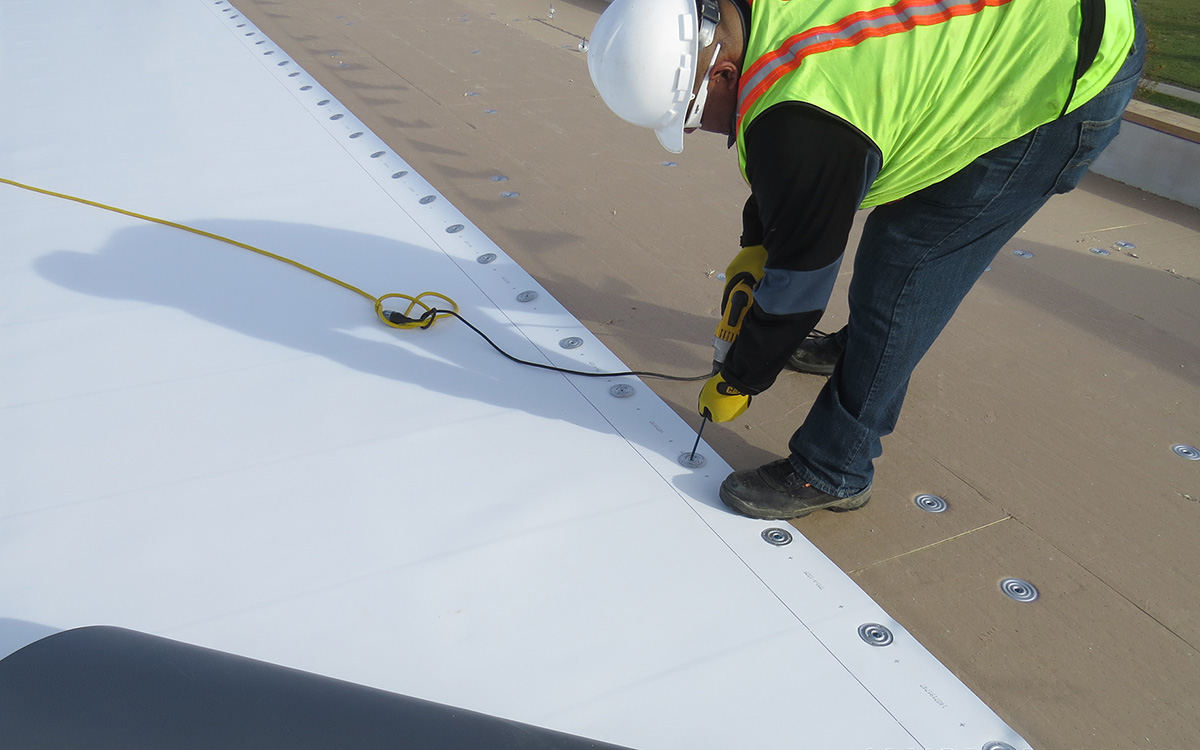
Modified Bitumen Roofing
Modified Bitumen Roofing — the polymer-reinforced evolution of traditional built-up roofing — is deeply embedded in Tacoma's commercial building stock. The older waterfront buildings along the Thea Foss Waterway, the mid-century industrial properties in South Tacoma and Nalley Valley, and the neighborhood commercial blocks on Pacific Avenue and Sixth Avenue all carry modified bitumen systems installed across the 1980s through 2000s. For new replacements on those same building types, mod-bit remains a strong specification — the Pacific Northwest's cool, damp climate is genuinely well-suited to SBS modified systems, and torch-applied SBS in particular delivers weld quality that performs exceptionally in sustained-rain environments.
Modified bitumen comes in two primary formulations: SBS (styrene-butadiene-styrene), which is rubber-modified for flexibility and cold-temperature performance, and APP (atactic polypropylene), which is plastic-modified for high-temperature resistance and UV stability. In Tacoma's climate, SBS is the more appropriate specification in most cases. SBS modified bitumen remains flexible at Pacific Northwest winter temperatures — down into the low 20s on freezing nights — and its flexibility means it accommodates the thermal movement of a large commercial roof deck without cracking at seams or laps. APP's primary strength — resistance to heat-induced softening — is less relevant in a climate with fewer than two days above 90°F annually.
Torch-applied SBS is the installation method we prefer on Tacoma commercial buildings where the scope and substrate allow it. The torch creates a fusion weld between the cap sheet and base sheet, and between the membrane and the substrate at the lap, that is fundamentally different from cold-adhesive or self-adhered installation — the bitumen is actually melted and consolidated at the seam rather than bonded with a separate adhesive. In a sustained-rain environment where lap integrity is tested every October through March, that fusion bond outperforms adhesive-bonded laps over the long term. We train our torch crews on proper heat management and seam inspection — the characteristic "fish mouth" bead at the lap edge is the visual confirmation that the membrane was properly heated and the seam is fully consolidated.
Self-adhered SBS systems are the appropriate specification when torch application is prohibited — on occupied buildings where the open-flame risk cannot be managed, on substrates that cannot tolerate torch heat, or on projects where the local authority having jurisdiction has restricted torch work due to fire risk. Self-adhered SBS has improved significantly in recent years and performs well in moderate Pacific Northwest temperatures, but it requires clean, primed, and dry substrates for full adhesion. The challenge in Tacoma's shoulder seasons — when temperatures are cool and humidity is high — is ensuring that the substrate and the self-adhered membrane are both in the correct temperature range for the adhesive to activate properly.
Historic buildings in Downtown Tacoma, the Stadium District, and Old Town present modified bitumen projects where the visual profile of the roof system is as relevant as the waterproofing performance. Many of these buildings have parapets, roof terraces, and multi-level roof configurations that define their architectural character. Modified bitumen's low profile — it adds minimal height to the existing assembly — makes it compatible with historic buildings where maintaining parapet cap clearances and through-wall flashing dimensions is important. We have re-roofed historic masonry commercial buildings in Downtown Tacoma with torch-applied SBS systems that preserved the original flashing profiles and parapet dimensions specified in the original design.
The Nalley Valley industrial corridor and the South Tacoma commercial strips — areas with a mix of 1950s through 1970s commercial and light industrial buildings — have a high concentration of mod-bit roofs that are now in the 20- to 35-year age range. That range puts them at or past the expected service life for systems that have not had regular maintenance. We inspect these roofs for characteristic end-of-life indicators: cap sheet granule loss exposing the bitumen surface, blistering between the base and cap sheet plies, shrinkage-induced cracking at the perimeter terminations, and fishmouths at lap seams that have opened over years of thermal cycling. When multiple indicators are present across more than 30% of the roof area, replacement planning is the honest recommendation.
Modified bitumen on Port of Tacoma facility buildings and older Tideflats warehouses often has marine air corrosion at the edge metal that progresses faster than the membrane itself ages. We commonly find two- to three-ply SBS systems in reasonable membrane condition with severely corroded gravel stops and edge flashings — the steel flange is perforated with rust while the membrane above it is still flexible and granule-intact. On those buildings, edge metal replacement combined with base and cap flashing renewal at the perimeter extends system life without a full tear-off, provided an infrared scan confirms dry insulation in the field.
Modified bitumen re-roofing on buildings with existing BUR or older mod-bit requires a tear-off of wet or deteriorated existing plies before new material is installed. We do not apply new torch-applied SBS over existing wet insulation or over an existing membrane that has lost its structural integrity — the new system cannot compensate for a compromised substrate. When we recommend a tear-off rather than a recover on an older mod-bit building in Tacoma, it is because the condition of what is underneath the existing membrane justifies the additional scope.
Roof Questions
How long does Modified Bitumen Roofing last in Tacoma?
A properly installed two-ply SBS system with granule cap sheet and regular maintenance typically achieves 20 to 25 years in the Pacific Northwest climate. The cool, damp conditions that characterize Tacoma are favorable for SBS — the rubber modifier keeps the membrane flexible at low temperatures, and the limited UV intensity slows surface oxidation of the bitumen. The primary variables that affect lifespan are installation quality, drain maintenance, and edge metal condition.
Is torch-applied modified bitumen safe for occupied buildings?
Torch-applied SBS can be installed on occupied buildings with proper fire watch protocols, substrate preparation to eliminate combustible conditions, and coordination with the building's fire suppression systems. We implement a written hot-work safety plan on every torch application project and maintain a fire watch after each torch session. On buildings where open-flame work is prohibited or where occupants present a safety management challenge, self-adhered SBS is the appropriate alternative.
Can modified bitumen be applied in Tacoma's rainy season?
Torch-applied SBS can be installed in light rain conditions that would preclude adhesive-based systems — the torch dries the substrate immediately ahead of the membrane application. However, standing water, active rain on the open substrate, and cold substrate temperatures below the manufacturer's minimum all require work suspension. We monitor conditions continuously and close open work areas with temporary protection at the end of each work session rather than leaving substrate exposed to overnight rain.
What is the difference between SBS and APP modified bitumen?
SBS is rubber-modified, giving it excellent low-temperature flexibility and elongation — it remains pliable in cold weather and can stretch without cracking. APP is plastic-modified, providing better high-temperature resistance and UV stability. For Tacoma's cool, overcast climate, SBS is the more appropriate formulation in most cases. APP's advantages are most relevant in hot-climate applications where the membrane surface reaches extreme temperatures — a scenario that rarely applies in Pierce County.
My Pacific Avenue building has a BUR roof — can it be re-roofed with modified bitumen?
Yes. Modified bitumen is a common replacement system for BUR on older commercial buildings, and it maintains a compatible low-profile character that works with historic parapet heights and flashing dimensions. The existing BUR must be evaluated for insulation moisture content and structural condition before a recover or tear-off decision is made. A properly executed SBS replacement on a BUR building in Downtown Tacoma or the Stadium District is a 20-plus-year solution with familiar material behavior and widely available repair capability.