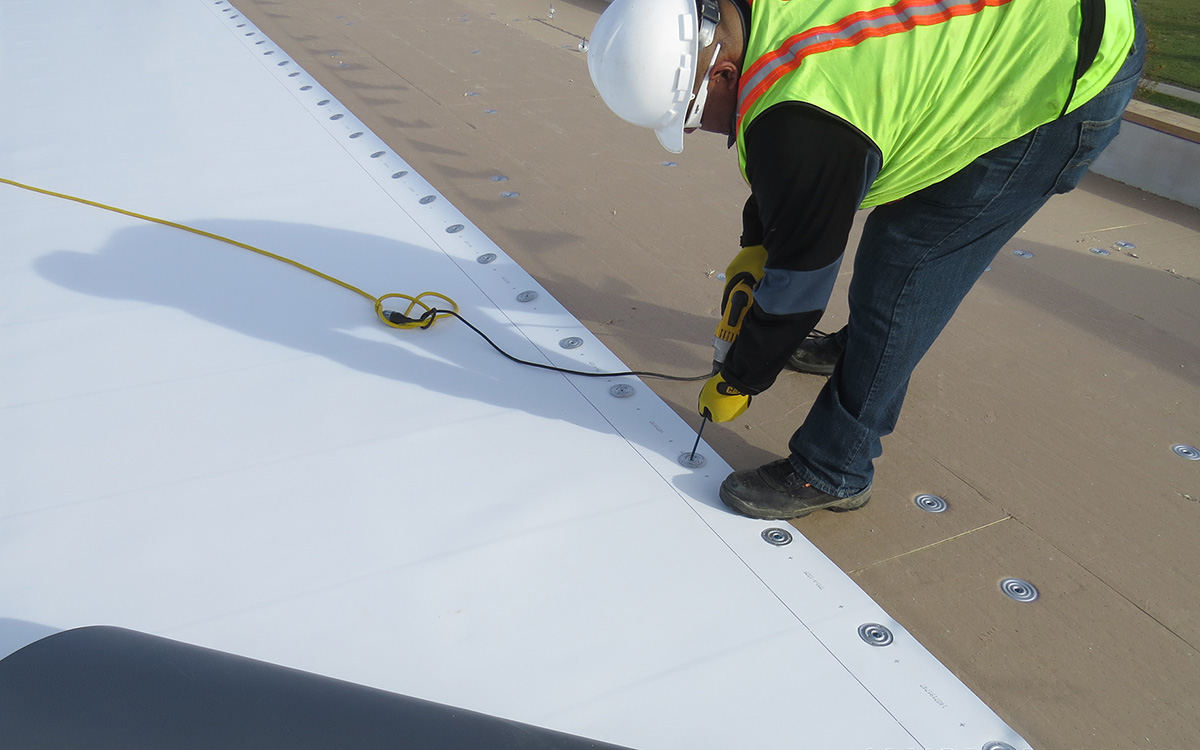
Roof Recover and Overlay
Roof recover — installing a new membrane system over an existing roof without a full tear-off — is an appealing option for Tacoma commercial building owners who want to extend their roof's service life while avoiding the cost and disruption of a complete system removal. On the right building with the right existing conditions, a recover is a legitimate 15- to 20-year solution. On the wrong building with wet insulation beneath the existing membrane, a recover is an expensive mistake that seals a deteriorating problem inside a new assembly. In the Pacific Northwest, where roofs accumulate wet insulation faster than dry-climate buildings, the moisture verification step before any recover decision is not optional.
Tacoma's sustained fall and winter rain — 42 inches annually with November and January as the peak months — gives moisture more opportunity to infiltrate a deteriorating membrane and saturate the insulation below it than most other U.S. markets. A TPO or EPDM roof that has been in service for 15 years with a history of minor lap seam delamination has likely allowed some water entry, and in the Pacific Northwest's cool, damp climate, that moisture does not dry out between rain events. It dwells in the insulation for months, spreading laterally through the insulation boards by capillary action. By the time the interior conditions are bad enough to cause a visible drip, the insulation saturation may extend well beyond the obvious leak location.
We conduct infrared thermal scans or nuclear moisture surveys on every building where a recover is being considered as an alternative to tear-off. The infrared scan is performed after sunset when the temperature differential between wet and dry insulation — wet insulation releasing stored heat more slowly than dry — creates detectable thermal signatures. We map the wet insulation areas against the total roof area and provide the owner with a percentage: under 10% wet insulation is a reasonable recover candidate; 10% to 25% requires targeted tear-out of wet sections before recovering the balance; over 25% wet insulation tips the cost-benefit analysis toward full tear-off because the wet material removal and replacement cost approaches the cost of a complete tear-off anyway.
Frederickson Industrial Center and Tideflats warehouse buildings are the most common recover candidates in the Tacoma market. These large-footprint, single-story buildings have roof areas that make tear-off cost-prohibitive relative to a well-executed recover on a dry substrate. A 150,000-square-foot Frederickson warehouse with dry insulation confirmed by a moisture scan is an excellent recover candidate — new recovery board over the existing membrane, mechanically attached or adhered new TPO or PVC, and 15 to 20 additional years of service life at a fraction of tear-off replacement cost. The same building with 40% wet insulation is not, and we tell owners that directly.
Building code layer count limits are a practical constraint on recover decisions. Washington State building code and most roofing manufacturer requirements limit commercial roofs to two membrane layers maximum in most configurations. A building that already has a recovered roof — an original BUR under an EPDM recover, for example — has reached its layer limit and requires a tear-off before a new system can be installed. We verify existing layer count during our initial inspection before proposing a recover, because a recover proposal that cannot be executed under code is not a proposal — it is a problem to discover at permit submission.
Recovery board specification for Tacoma recover projects takes into account the existing membrane condition as a substrate. An existing EPDM roof with surface oxidation and minor wrinkles requires a half-inch or quarter-inch recovery board to provide a smooth, stable substrate for the new membrane — the recovery board bridges over surface irregularities that would otherwise telegraph through a thin new membrane and create stress concentrations. On an existing TPO with a generally flat, sound surface, a thinner recovery board or, in some configurations, direct application over the existing membrane is possible, subject to manufacturer requirements for the new system.
Phased recover on large industrial buildings — completing the project in sections over multiple mobilizations — is a legitimate approach for owners who need to manage capital expenditure across budget years or who cannot accommodate a full-building roofing operation simultaneously. Each section must be properly terminated and water-tight at the end of each phase, with a clean transition detail at the boundary between the completed recover and the existing membrane awaiting its turn. We plan phase boundaries at natural roof breaks — expansion joints, parapet dividers, or structural bay lines — to ensure clean, maintainable terminations.
After a recover is complete, the owner has a new manufacturer warranty on the new system but not on the existing membrane below it. The existing membrane is now an interior component of a multi-layer assembly, and its condition at the time of recover becomes the baseline. Moisture scan documentation taken before the recover is the evidence that the substrate was dry at installation — that documentation protects the owner if a future moisture condition develops and raises questions about whether the wet insulation was present before or after the recover was executed.
Roof Questions
How do I know if my Tacoma warehouse is a good recover candidate?
The three qualifying conditions are: the existing insulation is confirmed dry by infrared or nuclear moisture scan; the existing roof deck is structurally sound; and the current layer count is below the code-maximum for your building type. If all three are true, a recover is worth pricing alongside a tear-off replacement so you can make a cost-informed decision. If insulation moisture is present, the recover option narrows or closes depending on the extent.
How much does a roof recover save compared to full replacement?
On a large Tacoma industrial building, a recover typically saves 20 to 35 percent compared to a full tear-off and replacement, primarily by eliminating tear-off labor and disposal cost. The savings are most significant on buildings with large simple-slope roof areas where tear-off is a major cost component. On smaller buildings with complex penetration layouts, the savings percentage is lower because the flashing and detail work cost is similar regardless of whether a tear-off is executed.
Can you recover a BUR roof with a single-ply membrane?
Yes, with recovery board installed between the existing BUR and the new single-ply system. The recovery board provides the smooth substrate required for single-ply application and the code-required separation between bituminous and polymer-based systems. This is a common approach on older Tacoma industrial buildings that have original BUR — recovering with TPO or EPDM over recovery board extends the building's roofing life without the cost and waste of full BUR tear-off, provided the existing insulation is dry.
Does a recover require a building permit in Tacoma?
Re-roofing projects, including recovers, typically require a City of Tacoma building permit when the scope involves structural modifications, drainage changes, or when the project triggers energy code compliance review. We handle permit applications on all recover scopes and verify whether the specific project triggers permit requirements before submitting. Maintenance-level repairs generally fall within exemptions, but a full recover across the building envelope is almost always a permitted scope.
What happens if wet insulation is found during a recover project?
When a moisture scan identifies wet insulation zones before the recover begins, we cut out and replace those sections of insulation and membrane before installing the new recovery board and membrane over the balance of the roof. If wet insulation is unexpectedly found during the recover installation — an area the scan missed or a section where saturation was below detection threshold — we stop, document the condition, and provide the owner with a change-order scope for the additional tear-out and replacement before proceeding. We do not install recovery board over known wet insulation under any circumstances.