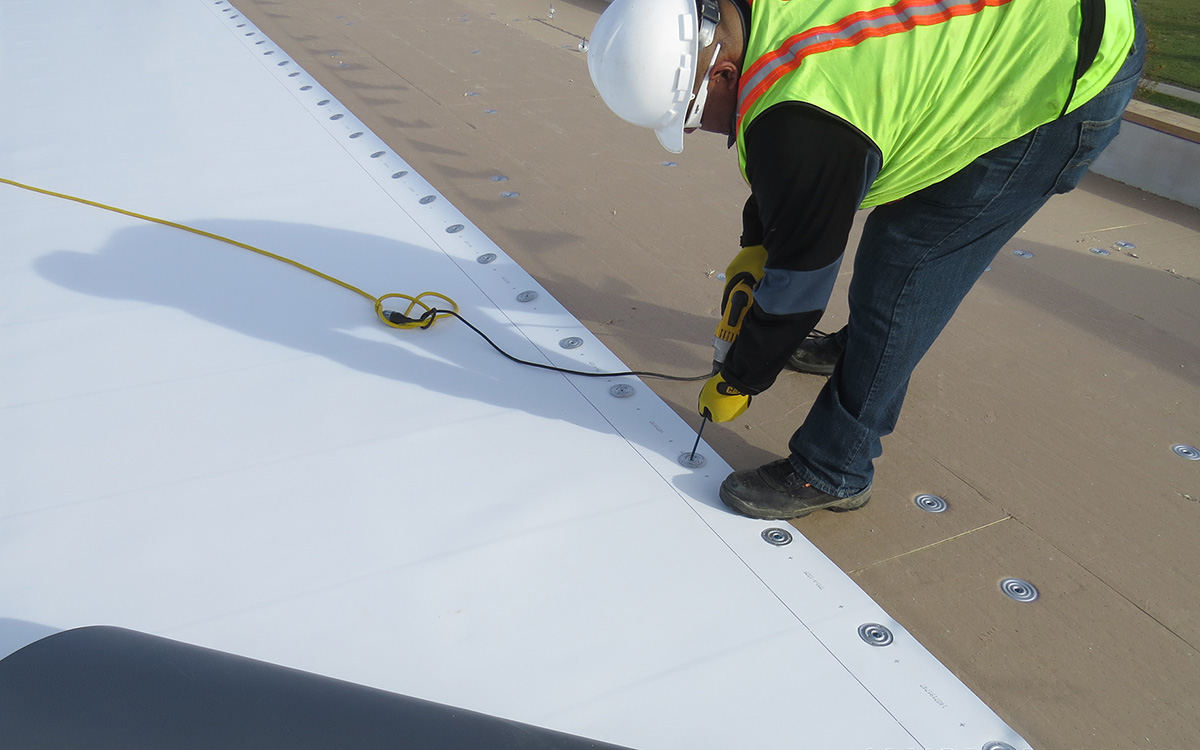
EPDM Roofing
EPDM — ethylene propylene diene monomer — is the black rubber membrane that became the dominant re-roofing system across Pacific Northwest commercial buildings through the 1990s and 2000s, and Tacoma's industrial and commercial stock carries a significant installed base of it. Frederickson Industrial Center warehouses, older Tideflats manufacturing buildings, and the mid-century commercial properties along Pacific Avenue and South Tacoma Way are all places where we regularly find EPDM that was installed 15 to 25 years ago and is being evaluated for its remaining serviceable life or a recover decision.
The Pacific Northwest climate is genuinely favorable for EPDM longevity relative to other regions. The primary degradation mechanism for EPDM is UV exposure — ozone cracking and surface oxidation that progresses fastest in high-UV, high-temperature environments. Tacoma's cloud cover, moderate temperatures, and rare extreme heat days mean that EPDM here ages more slowly on the surface than in California or the Southwest. A 20-year-old EPDM roof in Tacoma may show surface chalking and minor shrinkage at the perimeter, but have field membrane that is still flexible and substantially intact — a contrast with the same-age membrane in a sunnier climate that may be brittle and cracking throughout.
What does matter for EPDM in Tacoma is lap seam integrity. The bonded laps — where one sheet overlaps the adjacent sheet and the two are joined with EPDM bonding adhesive or factory-applied tape — are the critical vulnerability in a sustained-rain environment. Lap adhesive that was not properly activated during installation, or that has delaminated over time due to thermal cycling, allows water to wick into the lap and travel laterally before finding a path to the building interior. We find lap seam failures on EPDM roofs of all ages in Tacoma, and they are particularly common on roofs installed in the late 1990s and early 2000s when solvent-borne bonding adhesives were transitioning to water-borne formulations with different application requirements.
Seam probing is a standard part of every EPDM inspection we perform. We run a flat probe tool across every lap seam on the roof, pressing into the seam edge and noting any location where the probe penetrates the lap. On a sound seam, the probe skims across the bonded surface without entry. On a delaminated seam, it slides in easily — a condition that looks fine from above but is actively allowing water infiltration during rain. Those locations get marked, documented, and addressed with seam repair using reinforced lap sealant or heat-welded EPDM patches.
EPDM shrinkage at perimeter terminations is the other age-related defect we find consistently on older Tacoma roofs. EPDM has a natural tendency to shrink slightly over time, and that shrinkage manifests as tension at the membrane edge where it terminates at the wall base flashing or at the edge metal. In severe cases, the shrinkage pulls the membrane away from the termination bar or counterflashing, creating an open gap that admits water directly at the wall-to-roof transition. On large Frederickson warehouse buildings where the perimeter is measured in hundreds of linear feet, a shrinkage-induced termination gap around the full building perimeter represents substantial water exposure risk.
Re-cover decisions on EPDM buildings require a moisture survey before committing to the approach. EPDM's water-vapor permeability is low enough that moisture entering the insulation below it tends to stay there — a wet insulation layer under EPDM on a Pacific Northwest building can accumulate moisture over years without obvious surface symptoms. We conduct nuclear moisture scanning or infrared surveys on EPDM roofs before recommending re-cover, because a recover installed over wet insulation traps that moisture and converts a manageable condition into a deteriorating one.
When EPDM replacement is warranted, the decision between a new EPDM system and transitioning to TPO or PVC depends on the building use, the owner's performance priorities, and in some cases the fastener attachment method available for the substrate condition. EPDM is the most cost-effective system for straightforward re-roofing scopes on buildings without chemical resistance requirements. TPO offers better heat-weldable seam quality for owners who want a more reliable seam bond. PVC is the appropriate choice where the building use involves chemical exhaust or grease exposure that EPDM does not resist well.
On Tideflats buildings where the choice is a recover versus a tear-off-and-replace, we evaluate substrate access for mechanical attachment, the condition of the existing EPDM as a substrate for recover board and new membrane, and the insulation moisture content. A dry, structurally sound EPDM roof is a reasonable substrate for a TPO or EPDM recover system with recovery board. A wet or wrinkled EPDM roof requires tear-off to address the underlying conditions before a new system is installed.
Roof Questions
How long does EPDM Roofing last in Tacoma's climate?
A properly installed EPDM system with sound lap seams and regular maintenance typically achieves 25 to 30 years in the Pacific Northwest climate. Tacoma's low UV intensity and moderate temperatures are favorable for membrane longevity. The variable that compresses lifespan is lap seam quality at installation — poorly bonded seams that begin delaminating within five years can undermine an otherwise healthy membrane much earlier than the surface condition would suggest.
Why is my EPDM roof leaking if the surface looks fine?
EPDM lap seam failures are the most common source of leaks on roofs where the field membrane appears intact. The seam runs beneath the surface overlap and is invisible during a walking inspection — it requires probing to detect. Perimeter termination gaps from membrane shrinkage are the second most common hidden source. We probe seams and inspect terminations systematically rather than relying on surface appearance alone.
Can EPDM be repaired, or does it need to be replaced?
EPDM repairs are highly effective when executed correctly. Lap seam failures are addressed with EPDM seam tape or lap sealant. Field membrane punctures and tears are repaired with peel-and-stick EPDM patches. Perimeter termination failures are re-terminated with new termination bar and lap sealant. A well-maintained EPDM roof can be extended significantly through targeted repairs before full replacement becomes necessary.
Is black EPDM a problem for energy performance in Tacoma?
In Tacoma's heating-dominated climate, black EPDM's low reflectivity is not the liability it would be in a cooling-dominated market. The surface absorbs solar heat during the limited summer months, which may modestly reduce heating loads on conditioned buildings. The energy performance difference between black EPDM and white TPO is less significant in Tacoma than in Phoenix or Dallas, and should not be the primary driver of system selection.
Can I install a white membrane over existing EPDM to improve reflectivity?
Yes — a silicone or acrylic coating applied over structurally sound EPDM converts the surface to white reflective and adds a secondary waterproofing layer. This is a common approach on EPDM roofs that are mid-life: sound membrane with some seam wear and surface oxidation. The coating extends EPDM life and changes the thermal performance. The coating does not address wet insulation below the membrane, so a moisture survey is required before application.