Edge Metal Coping and Gutters
Edge metal, coping, and gutters are the perimeter system that defines whether a commercial roof drains correctly and whether the membrane termination holds against wind-driven rain. In Tacoma, those components carry a heavier burden than in most markets — 42 inches of annual rain channeled through a perimeter gutter system, marine air from Commencement Bay accelerating corrosion on every ferrous and galvanic connection, and November wind events that drive water horizontally across parapet caps and into wall assemblies. When the perimeter system fails, the consequences are rarely limited to the roof. Water tracks into wall cavities, stains interior ceilings, and in masonry buildings can cause freeze-thaw spalling of the brick face.
Marine air corrosion is the defining variable on edge metal performance for Tideflats and waterfront buildings. Standard galvanized steel gravel stops and drip edges corrode from the exposed flange inward, typically showing rust bleed-through on the face within 10 to 15 years on buildings with direct bay exposure along the Thea Foss Waterway or Marine View Drive. The failure mode is perforation of the gravel stop flange at the roof level, which allows water to bypass the edge and enter the wall-to-roof transition. On those buildings, we specify stainless steel fasteners as a baseline and evaluate whether aluminum with a factory Kynar coating or copper is appropriate for the coping cap material based on the building's specific exposure and the owner's replacement interval expectations.
Historic masonry buildings on Pacific Avenue, in the Stadium District, and along the older commercial blocks of the Proctor District have masonry parapets with coping conditions that range from sound limestone or cast stone to severely deteriorated brick with failed mortar joints. The coping cap — whether it is sheet metal, precast concrete, or stone — is the primary barrier against water entering the top of the parapet wall. When coping cap joints open or the cap lifts, water saturates the masonry core and eventually finds its way to the interior wall surface or the roof membrane base flashing. We coordinate masonry coping repair with the roof base flashing work so both conditions are addressed in a single mobilization.
Gutter sizing on Tacoma commercial buildings is a calculation that needs to account for the November and January peak rainfall months, not annual averages. A gutter system designed for the 2-inch-per-hour design storm that governs much of the country is undersized for a sustained three-day Pacific atmospheric river event that delivers concentrated flow over a long duration. We evaluate existing gutter capacity against the contributing roof area and slope, and recommend upsizing or adding downspout locations when the current system shows evidence of overflow — staining on the building face below the gutter, erosion at downspout discharge points, or soffits that show water damage from gutter overflow backing up under the eave.
Industrial buildings in the Frederickson Industrial Center and across the Port manufacturing corridor typically do not have conventional gutters — they drain to interior drains or to scuppers through the parapet. But those buildings do have edge metal at the eave and rake, and the condition of that metal determines whether water exits the roof cleanly or infiltrates the wall-to-roof joint. On large-format metal-roofed industrial buildings, we inspect and replace rake trim and eave trim as part of roofing repair scopes because a failed trim piece creates a water entry path that is independent of the membrane condition.
Box gutters concealed within building parapets — common on older Downtown Tacoma commercial buildings from the early twentieth century — are a specialized repair item. When a concealed box gutter deteriorates, water can overflow into the parapet cavity and the building wall for years before the interior damage becomes visible. We re-line deteriorated box gutters with EPDM or PVC membrane material, re-establish the correct slope to the outlet, and ensure the overflow condition — a scupper or controlled overflow point — is functional so that a blocked drain outlet does not result in parapet flooding.
Downspout discharge and the management of roof water at grade is relevant for Tacoma commercial buildings in areas with combined stormwater systems. The City of Tacoma has active stormwater management requirements, and some older commercial properties have illegal cross-connections between roof drainage and sanitary sewer. We note discharge conditions during inspections and refer building owners to licensed civil engineers or the City's stormwater program when we observe conditions that appear to be code non-compliant.
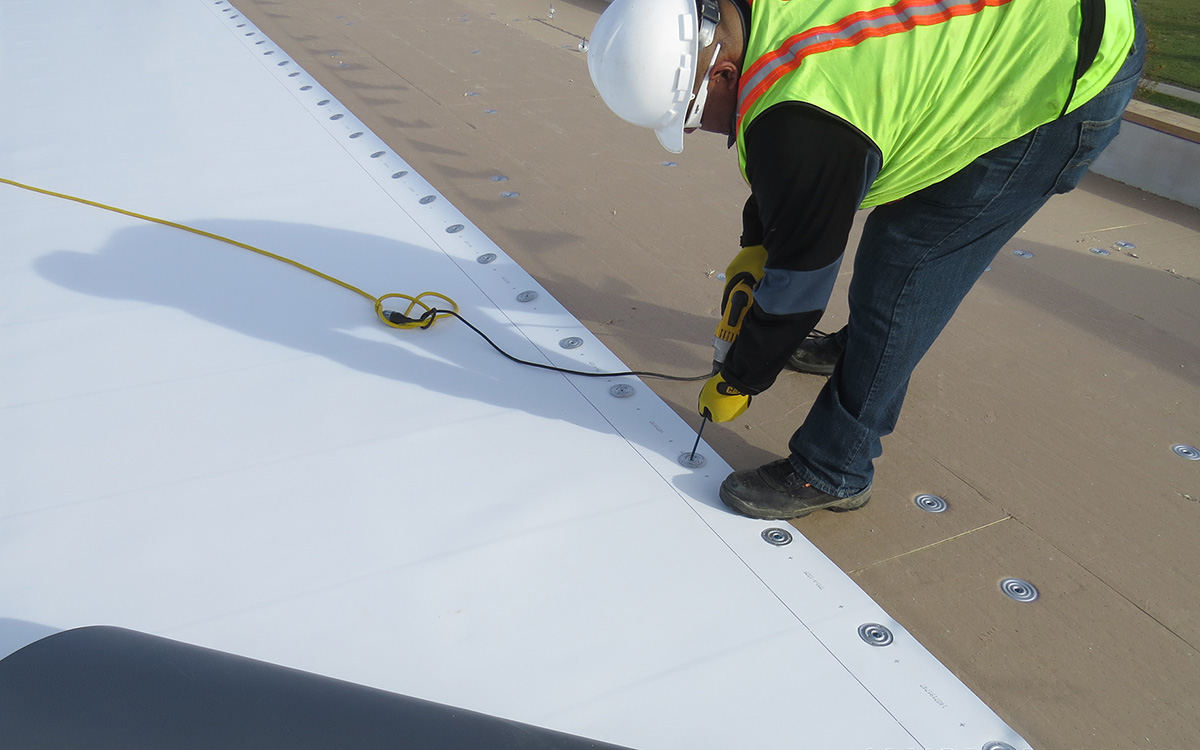
Every edge metal and gutter replacement we perform includes a review of the membrane termination at the edge — the point where the roof membrane laps over or tucks into the edge metal. That termination is the critical seal between the membrane system and the perimeter metal, and it degrades independently of both. A new gutter with a failed membrane termination is still a leak. We address both conditions together as a coordinated scope rather than treating edge metal as a standalone item disconnected from the roofing system.
Roof Questions
How often should commercial gutters be cleaned in Tacoma?
Twice per year is the minimum for most commercial buildings — once in late October or early November before the rain season peaks, and once in late spring after deciduous tree leaf drop is complete. Buildings adjacent to mature street trees in the Proctor District, Stadium District, or Sixth Avenue commercial area accumulate leaf debris faster and may need a third cleaning in early December after a late leaf-drop season. Clogged gutters on a Tacoma building during November are an active overflow event waiting to happen.
What type of edge metal is best for buildings near the Tacoma waterfront?
For buildings with direct marine air exposure — Thea Foss Waterway, Old Town Tacoma, Marine View Drive — we specify aluminum with a factory Kynar 500 coating and stainless steel fasteners. Copper is the longest-service option but carries a significant material cost premium. Galvanized steel gravel stops are acceptable for inland Tacoma locations but should not be used within a half-mile of the waterway due to accelerated corrosion from salt-laden air.
My coping caps keep blowing off in winter storms. What is the fix?
Coping caps that blow off are either undersized for the parapet width, have failed anchor clips, or are missing continuous cleat fastening at the cap edges. Wind uplift on a parapet cap during a Tacoma marine storm can be substantial, particularly on buildings with a south or west exposure that faces the storm track. We replace caps with properly anchored continuous cleat systems and size the cap profile to the parapet width per SMACNA standards so wind cannot get under the leading edge.
Can gutter problems cause interior wall damage on a commercial building?
Yes, and it is more common than owners expect. Overflowing gutters deposit water against the building face repeatedly, saturating the wall assembly at the base of the overflow point. On masonry buildings, that repeated saturation leads to efflorescence, spalling, and in severe cases, structural mortar deterioration. On metal panel buildings, it accelerates panel corrosion at the base. We treat gutter overflow conditions as a building envelope problem, not just a roof maintenance item.
What is the difference between a coping cap and a parapet flashing?
A coping cap is the horizontal cover at the top of a parapet wall — it sheds water to both sides of the wall and protects the masonry or framing core. A parapet flashing is the vertical component at the roof-to-wall interface that connects the roof membrane to the wall. Both are required for a watertight parapet condition. A building with a sound coping cap and a failed parapet base flashing will still leak at the roof-wall joint. We inspect and address both conditions together.