Emergency Dry In Tarping
Emergency dry-in and tarping is the service that gets called when a commercial building's roof has been compromised by a storm event and interior protection cannot wait for a scheduled repair crew. In Tacoma's wet season — roughly October through March — the gap between a roof failure and interior damage is measured in hours, not days. A displaced flashing, a membrane tear from wind uplift, or a failed skylight frame during a November Pacific storm means water is moving into the building immediately, and the only question is how much damage accumulates before the entry point is sealed.
The geography of Tacoma's commercial building stock creates specific emergency response challenges. Tideflats warehouse buildings — many of them 100,000 square feet or larger with 24-foot eave heights or more — require aerial lift equipment for safe roof access. Getting that equipment mobilized, transported, and positioned at a building with active dock operations at 11 PM on a November Wednesday is a logistics problem that has to be solved under time pressure. We maintain relationships with equipment rental yards in the South Sound and keep current on equipment availability and delivery lead times so that when an emergency call comes in, the access question has an answer before we arrive on site.
Port of Tacoma logistics facilities and rail-served Tideflats manufacturing buildings add a layer of access complexity beyond equipment staging. Many of these facilities have 24-hour operations with no interruptible window in dock or rail activity. Emergency dry-in on a building where the accessible perimeter is a 40-foot clear zone with a truck queue on one side and an active rail spur on the other requires a site-specific access plan and coordination with the facility's operations manager — not just a knock on the front door with a ladder. We know enough about the Port and Tideflats building access environment to ask the right questions when we take the emergency call.
JBLM contractor buildings in the Lakewood and Spanaway area have emergency access requirements that can slow response even when crews are available. After-hours access to buildings on or adjacent to JBLM often requires base security coordination, point-of-contact notification, and in some cases, military police escort for contractors on restricted-access areas. We have navigated those requirements enough times to know what the call tree looks like — the facility manager, then the base security office, then the emergency contractor access process. Having those contacts pre-established for buildings in our maintenance program cuts the access delay significantly.
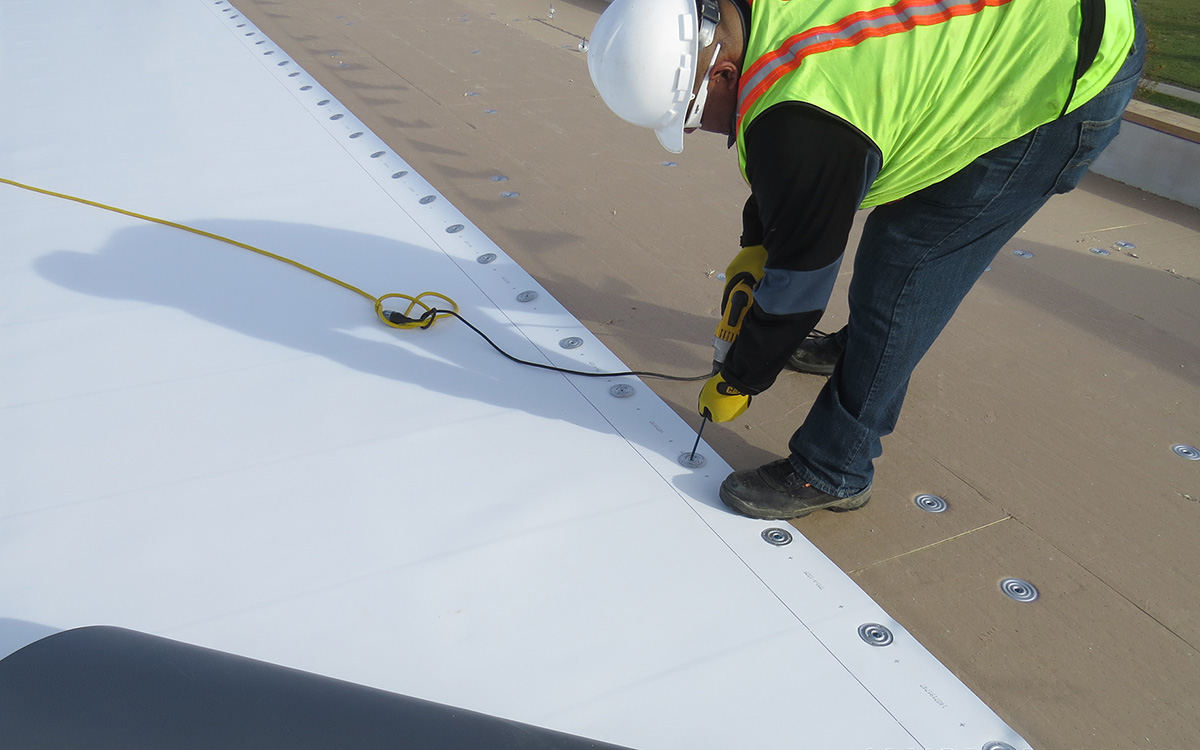
Temporary tarping on large flat commercial roofs is a more technical operation than it appears from the parking lot. A standard woven poly tarp on a 300-foot-wide warehouse roof in a Tacoma marine wind event is a sail that will destroy itself and potentially damage the building in under an hour. Emergency dry-in on large commercial flat roofs requires reinforced tarps or, better, temporary self-adhering membrane strips over the damaged area with ballasted cover boards to hold them in place. On membrane tears or open seams, we use peel-and-stick SBS membrane as a temporary seal that actually adheres to the substrate rather than a tarp that relies on ballast alone.
Smaller commercial buildings in the Stadium District, the Proctor District, and the Sixth Avenue Business District — the neighborhood retail and office buildings with pitched or low-slope roofs — have different emergency access dynamics. Access is typically straightforward with an extension ladder, the roof area is manageable for a two-person crew, and temporary tarping with proper ballasting is feasible. The constraint is more often the building's proximity to adjacent structures and the need to protect neighboring properties from debris or water displacement during the emergency response.
After stabilizing a building with a temporary dry-in, we provide the building owner with a written assessment of the damage and a proposed permanent repair scope within 24 hours. The temporary measure buys time, but it has a finite service life and should not be treated as a resolution. We are explicit about what the temporary system can and cannot withstand — a peel-and-stick patch over a membrane tear can handle another Pacific rain event, but it is not a substitute for a properly adhered permanent repair that addresses the underlying cause of the failure.
When storm damage is severe enough to warrant an insurance claim — a large membrane section blown off by wind, significant interior water damage, or structural damage to the roof assembly — we coordinate the emergency dry-in with the insurance documentation process. We take photographs of the damage before any temporary materials are applied, document the pre-repair condition in sufficient detail for an adjuster's review, and preserve physical evidence of the failure mode where practical. Starting the documentation at the emergency call, not the next business day, makes the subsequent claim process substantially smoother.
Roof Questions
How quickly can you respond to a roofing emergency in Tacoma?
For buildings in our maintenance program, we target same-day response for emergency calls received before 2 PM and next-morning response for after-hours calls, weather and access permitting. For new clients, honest response time depends on crew and equipment availability. Emergency calls during the first major November storm of the season — when every commercial property manager in Pierce County is calling simultaneously — will have longer response times than calls during a mid-summer unusual rain event. We triage by severity of interior damage risk when managing multiple simultaneous emergencies.
Is emergency tarping covered by commercial property insurance?
Reasonable emergency mitigation costs — including temporary tarping and dry-in materials applied to prevent further damage after a covered loss — are typically included in commercial property insurance claims. Document the condition before applying temporary materials, retain receipts for emergency labor and materials, and notify your insurer promptly. We provide an itemized invoice for emergency work that meets standard insurance documentation requirements.
How long can a temporary tarp or emergency dry-in last on a commercial roof?
A properly applied peel-and-stick temporary membrane over a discrete damage area can hold through multiple rain events — typically 30 to 90 days — but it is not a permanent solution and should not be treated as one. Standard woven poly tarps on flat commercial roofs are shorter-lived in Pacific Northwest wind conditions and should be replaced with a permanent repair as soon as the weather window allows. We do not apply temporary dry-in and walk away without scheduling the follow-up permanent repair.
My warehouse has constrained dock access — how do you handle equipment staging?
We identify the staging constraints in the initial call and plan accordingly. Options include aerial lift equipment sized for the specific building height and access corridor, temporary dock closure for a defined time window coordinated with the facility operations manager, or staggered crew access using multiple smaller pieces of equipment that can navigate tighter approaches. We have worked on enough Tideflats and Port-adjacent buildings to understand that "standard" staging assumptions do not apply.
What should I do inside the building while waiting for emergency roof service?
Protect equipment and inventory from active water intrusion — move sensitive items out of the drip zone, place collection containers, and document interior damage with photos for your insurance claim. If water is near electrical panels, disconnect power to affected circuits and contact an electrician. Do not attempt to access the roof from inside the building without proper fall protection equipment. Call us, document the interior, and protect what you can reach safely from the floor.