Commercial Roofing
Commercial Roofing in Tacoma, Washington covers a wider range of building types, exposure conditions, and system requirements than almost anywhere else in the Pacific Northwest. Within Pierce County alone, a Commercial Roofing contractor serves Port of Tacoma logistics warehouses with 300,000-square-foot flat roofs, JBLM contractor facilities with federal building requirements, historic masonry buildings on Pacific Avenue that have been re-roofed four times over a century, Tideflats chemical processing plants with chemical-resistant membrane requirements, and transit-adjacent mixed-use buildings near Tacoma Dome Station that require occupied-building phasing and noise management. No single roof system, no single approach, and no single schedule template works across that entire portfolio.
The foundational weather reality shaping Commercial Roofing decisions in Tacoma is 42 inches of annual precipitation, front-loaded into the fall and winter months. November delivers 7.18 inches on average — not in heavy downpours, but in sustained, low-intensity rain that runs for days and infiltrates every unsealed penetration, every open lap seam, and every drain that has not been cleared since summer. January follows with 6.06 inches. The buildings that make it through those two months without interior water damage are the ones with properly designed drainage, sound membrane systems, and a maintenance program that addresses drain clearance and flashing conditions before the rain arrives.
Marine air from Commencement Bay and the Tideflats is the factor that distinguishes Tacoma Commercial Roofing from the rest of the South Sound market. Salt-laden moisture carried inland on prevailing southwest winds accelerates corrosion on edge metal, fasteners, and any exposed ferrous or galvanic connection at the roof perimeter. Buildings on the Thea Foss Waterway and in the Tideflats industrial corridor routinely show fastener and edge metal corrosion at intervals that would surprise owners familiar only with inland building performance. We account for marine exposure in every material specification we make for waterfront and near-waterfront properties.
The Port of Tacoma and the surrounding manufacturing industrial areas — the Tideflats five-thousand-acre planning area and the Frederickson Industrial Center with its 7.3 million square feet of industrial space — represent the largest concentration of commercial roof square footage in the Pierce County market. These buildings present logistical challenges that downtown or suburban commercial buildings do not: continuous dock operations that constrain equipment access, rail-served loading areas that cannot be blocked, and facility security protocols that require advance coordination for contractor access. We have worked on enough Port-adjacent and Frederickson buildings to know how to plan access and phasing without disrupting operations.
JBLM and the surrounding contractor facility belt in Lakewood, Spanaway, and University Place bring a different set of requirements. Federal government and defense-contractor leases often specify approved contractor lists, approved material systems, and documentation standards that exceed standard commercial practice. Permits on JBLM-owned property are governed by federal authority rather than City of Tacoma building department — a distinction that matters for scheduling and inspection coordination. We maintain the documentation and compliance infrastructure to work in those environments.
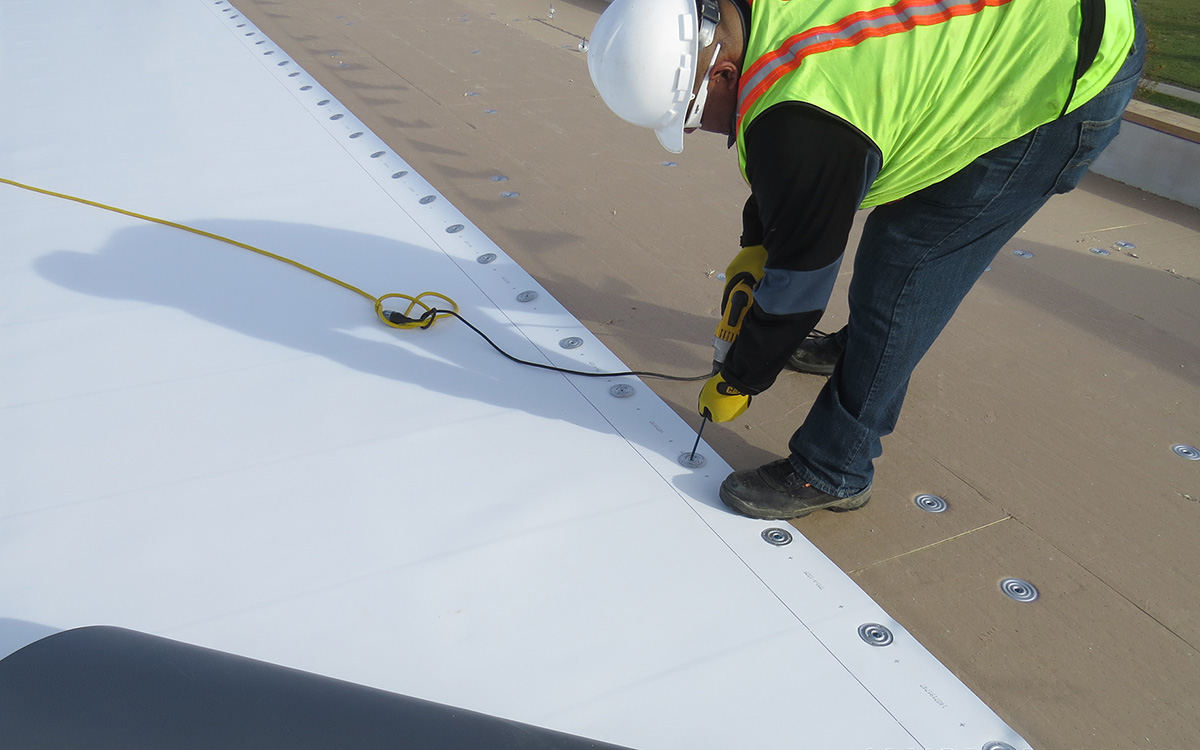
Single-ply membranes — TPO, PVC, EPDM, and KEE — dominate new roofing and replacement work across Tacoma's commercial market. TPO is the most common system on Frederickson and Tideflats warehouse new construction. PVC is the chemical-resistance choice for food processing and chemical storage facilities. EPDM is prevalent on older re-roofed industrial buildings and is well-suited to the Pacific Northwest's cool, damp climate. KEE is the premium choice for chemical manufacturing environments where standard PVC is insufficient. We work fluently across all four single-ply systems and carry installer certifications for warranty issuance on each.
Legacy systems — built-up roofing and modified bitumen — remain relevant on older Tacoma buildings where re-cover or repair of the existing system is more appropriate than full replacement. The older industrial buildings along Pacific Avenue, in South Tacoma, and in the Hilltop neighborhood often have multi-ply BUR that, with proper drain maintenance and targeted flashing repairs, can be extended well beyond what their age would suggest. Modified bitumen is our preferred system for replacements on those older buildings where maintaining the original low-profile character and drainage pattern is important.
Our Commercial Roofing work in Tacoma is supported by a preventive maintenance program that covers biannual inspection, drain clearing before the November season, and an annual condition report that feeds into the building owner's capital planning. The owners who weather Tacoma's rain seasons without emergency calls are overwhelmingly the ones who invest in that maintenance cycle. The ones who call us in November with three interior drips and a bucket brigade are the ones who have not had a roof looked at in five years. We are available for both scenarios — but we prefer to have the conversation in August.
Roof Questions
What Commercial Roofing systems are most common in Tacoma?
TPO single-ply dominates new construction and replacement work on warehouse and light industrial buildings across Frederickson and the Tideflats. EPDM is widely installed on older commercial and industrial buildings that were re-roofed in the 1990s and 2000s. Modified bitumen is common on older downtown and neighborhood commercial buildings. PVC is the system of choice for chemical resistance applications. Built-up roofing remains in place on the oldest building stock and is still installed when the project calls for it.
How does Tacoma's rain affect the Commercial Roofing decision?
Volume and duration drive Tacoma's roofing design requirements more than intensity. Drains must be sized for sustained flow, not just peak-intensity events. Low-slope roof designs must account for the fact that any ponding area will hold water for 48 to 72 hours after a major storm. Membrane systems must maintain seam integrity through months of continuous moisture exposure. Maintenance programs must prioritize drain clearance before November, not after.
Do you work on occupied commercial buildings?
Yes, the majority of our work is on occupied buildings — Port logistics facilities running three shifts, retail buildings that cannot close, industrial plants with production schedules. We plan work sequences that isolate the active work zone from building operations, use materials and methods that minimize odor and noise, and coordinate daily with the facility manager to adjust the schedule around operational requirements.
How do I choose between roof repair, re-cover, and full replacement?
The decision starts with a condition assessment and infrared moisture scan. Dry insulation and isolated membrane damage supports a repair or re-cover approach. Widespread wet insulation, structural deck deterioration, or a membrane that has reached end of useful life across the majority of the roof area points to full replacement. We provide an honest assessment with supporting data rather than defaulting to the highest-revenue recommendation.
What should I know about Commercial Roofing warranties in Washington State?
Washington State does not impose specific warranty requirements beyond standard contract law, but manufacturer-backed warranties on Commercial Roofing systems require installation by a certified applicator, minimum membrane thickness, and often a manufacturer inspection at project completion. We carry current certification on all major single-ply systems and handle the warranty registration process as part of project closeout. Workmanship warranties from our firm are documented separately from the manufacturer warranty.