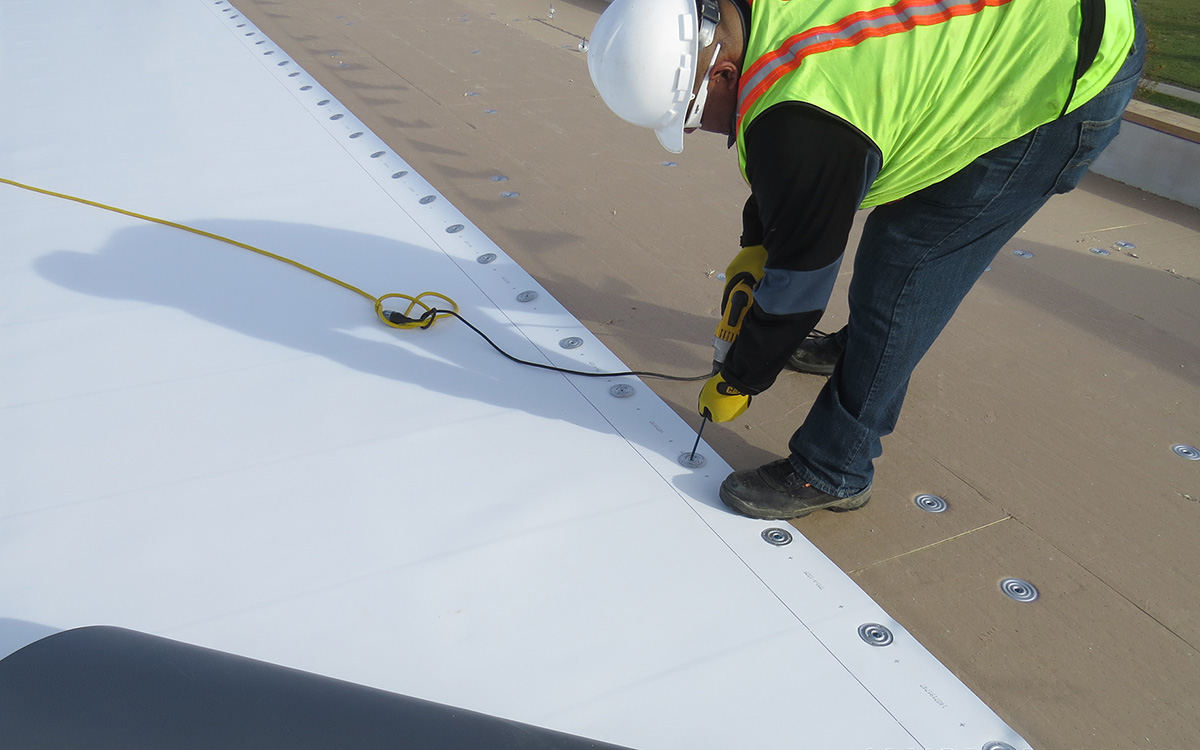
KEE Single-Ply Roofing
KEE — ketone ethylene ester — is a single-ply membrane that most commercial building owners in Tacoma have never heard of, but that the owners and facility managers of chemical processing plants, food manufacturing facilities, and specialty industrial buildings in the Tideflats and Frederickson Industrial Center need to know about. KEE is a premium-tier chemical-resistant membrane engineered for environments where standard PVC or TPO would degrade from exposure to chemical exhaust, cooking oils and fats, industrial solvents, or other compounds that attack conventional membrane plasticizers. In Tacoma's industrial corridors, those environments are not rare.
The Tideflats manufacturing area and the Port of Tacoma industrial complex host a range of operations — chemical storage, food processing, maritime maintenance facilities, fuel handling — where rooftop exhaust systems discharge compounds that are incompatible with standard single-ply membranes. PVC membranes rely on plasticizers that can migrate out of the membrane when exposed to certain oils and solvents, causing the membrane to become brittle and crack. TPO's resistance profile is better than PVC for some chemical exposures but still has limits. KEE membranes are formulated without the plasticizer migration vulnerability that affects PVC and offer broader chemical resistance than standard TPO, making them the appropriate specification for buildings where the roof membrane is in direct or near-direct contact with aggressive exhaust streams.
Food processing facilities in the Frederickson and Sumner-Pacific manufacturing corridor — meat processing, seafood handling, commercial baking — discharge cooking oils and grease-laden exhaust from rooftop ventilation systems. Animal fats and vegetable oils that condense on the membrane surface directly below exhaust terminations attack conventional single-ply membranes over time, degrading the membrane in a localized pattern that expands as the exhaust cone deposits accumulate. KEE's resistance to lipid-based chemical exposure makes it the correct material for the membrane field on these buildings, not just at the penetration itself.
KEE membranes are heat-weldable — the same hot-air welding equipment used for TPO and PVC creates fusion-bonded seams that are as strong as the membrane field. This is a critical advantage over field-applied sealants or adhesive-bonded laps in chemical-exposure environments, because the seam is the point most vulnerable to chemical infiltration on any membrane system. A fusion-welded KEE seam eliminates the adhesive component entirely, leaving a continuous membrane surface with no chemical vulnerability at the lap joint.
On Port of Tacoma facility buildings and maritime maintenance operations along the waterfront, KEE's seam integrity in cool, sustained-wet conditions is an additional performance advantage. Pacific Northwest temperatures during the installation season — often in the 45 to 60°F range — are within the working window for heat-welded KEE but at the lower end for solvent-based adhesive systems. Heat welding is less temperature-sensitive than adhesive bonding, which means KEE can be installed in the shoulder-season weather windows that are standard in Tacoma without the adhesive performance concerns that affect some other systems in cool, damp conditions.
Roofing system transitions — where a KEE field membrane meets the penetration flashings, curb wraps, and terminations around dense industrial HVAC and exhaust equipment — require the same attention to detail as the field membrane itself. Tideflats and Port industrial buildings frequently have penetration densities that would be extraordinary in any other building type: roof-mounted exhaust fans, process exhaust stacks, make-up air units, condenser units, and utility chases can account for 30 to 50 penetrations on a single warehouse-scale roof. Each one is a potential chemical contact point, and each requires a properly detailed KEE flashing that extends the chemical resistance from the field membrane through the vertical component at the penetration curb.
We specify KEE roofing after a detailed review of the building's exhaust chemistry, discharge location and volume, and membrane exposure history. On buildings where a previous conventional membrane has failed prematurely in a localized pattern below rooftop exhaust equipment, the chemical exposure is confirmed by the failure pattern itself — we document the existing failure and its location relative to exhaust discharge before specifying the replacement system. KEE typically carries a cost premium of 15 to 25 percent over standard TPO on a square-footage basis, which is the right investment for buildings where the exposure environment would degrade a conventional membrane within five years.
Manufacturer warranties on KEE systems are available from Seaman Corporation (FiberTite) and a limited number of other manufacturers who produce the material. We are certified applicators for the systems we install and provide the manufacturer warranty registration documentation at project closeout. On industrial buildings where the chemical exposure environment makes warranty claims more likely than on a standard commercial building, the manufacturer certification and warranty documentation is a meaningful asset for the building owner's risk management record.
Roof Questions
How do I know if my Tideflats building needs KEE instead of standard TPO or PVC?
The indicators are rooftop exhaust from chemical processes, cooking operations, fuel handling, or solvent use; a history of premature membrane failure in localized areas below exhaust discharge points; or a building use classification that involves chemical storage or processing. If your building has any of these conditions, we evaluate the specific chemical exposure before recommending a membrane system. Standard TPO or PVC in a confirmed chemical-exposure environment is a false economy — the membrane will fail prematurely and the re-roofing cost will exceed the KEE premium many times over.
Is KEE roofing available with a manufacturer warranty?
Yes. Seaman Corporation's FiberTite KEE membrane is available with manufacturer-backed warranties including NDL options. Warranty terms require installation by a certified applicator and a manufacturer inspection at project completion. We carry the certification required to issue FiberTite warranties and handle the registration process as part of project closeout.
Can KEE be installed over an existing membrane as a recover?
In some configurations, yes — KEE can be installed over a recovery board on an existing sound substrate. The recover option requires a moisture survey to confirm dry insulation and an evaluation of whether the existing substrate is compatible with the recover board and new KEE system. On buildings where the existing membrane has been chemically degraded, tear-off is typically required to ensure the new system is installed over a sound, compatible substrate.
What is the lifespan of a KEE membrane in a chemical-exposure environment?
In environments where standard membranes would fail in 5 to 10 years due to chemical attack, a properly installed KEE system with appropriate chemical resistance for the specific exposure typically achieves 20 to 25 years of service life. Longevity depends on the specific chemical compounds, discharge volume and temperature, and whether the membrane is in direct contact with condensate or in the vapor plume only. We evaluate exposure severity as part of the system specification.
Does KEE roofing look different from TPO or PVC from the ground?
KEE membranes are available in white and light gray finishes similar to TPO. From ground level, a KEE roof is visually indistinguishable from a standard white single-ply system. The distinction is entirely in the material chemistry and performance characteristics — not the appearance. If your building's neighbors or tenants care about the rooftop appearance, KEE installs exactly as a standard commercial flat roof system looks from any exterior vantage point.