Movie Theater & Cinema Roofing
A Cinema Roof Is A Bridge With A Membrane On Top
The thing that sets a theater apart from every other big-box roof is what isn't underneath it: columns. Each auditorium has to be a clear span so no patron sits behind a post, which means the deck reaches across eighty, a hundred, sometimes a hundred and fifty feet in a single bay. That span moves. It deflects under snow load, it flexes with temperature, and the points where it moves most are exactly where membrane seams and fasteners get worked the hardest. We do not lay a cinema roof to a fastening pattern borrowed from a strip-retail spec. We pull the actual deck type, rib depth, and gauge, and we attach insulation and membrane to what the structure actually does over that span.
Tacoma's cinema landscape runs from large stadium-seating multiplexes near the Tacoma Mall and the South Hill retail belt out toward Lakewood, to neighborhood and independent houses including the historic Blue Mouse Theatre in the Proctor District and the restored Pantages and Rialto venues downtown that screen film as part of their programming. The newer multiplexes are clear-span steel-and-concrete construction; the older and historic houses carry decades of layered roofing over heavy timber or early steel framing. The two could not call for more different scopes.
The Roof Over A Multiplex Looks Like A Hospital's
Drive past the mechanical screening on a twelve-screen building and you would not guess it was a movie theater from the equipment alone. Each auditorium typically carries its own rooftop HVAC unit so one packed late show doesn't drag down the temperature in the matinee next door. Add concession kitchen exhaust, lobby heating vents, condensers for the walk-in coolers and the bar, and the projection-booth cooling that keeps laser projectors in spec, and the penetration cluster rivals what we flash on a medical building. Every curb, duct, and conduit run gets individually flashed and photographed before new membrane goes over it — there is no field-membrane shortcut past that work.
Acoustics Live In The Roof Assembly
A cinema sells silence between the speakers. Rain drumming on a thin deck, or sound bleeding from the auditorium next door, is a product defect in this business. The roof assembly is part of how that gets controlled. Mass and the insulation layers matter to the acoustic performance of the deck, and rooftop mechanical placed carelessly over an auditorium transmits vibration straight into the room below. We coordinate equipment curbs, isolation, and the insulation buildup with that reality in mind, rather than treating sound as somebody else's trade once the membrane is watertight.
Drainage Is The Long Game On A Flat Theater Roof
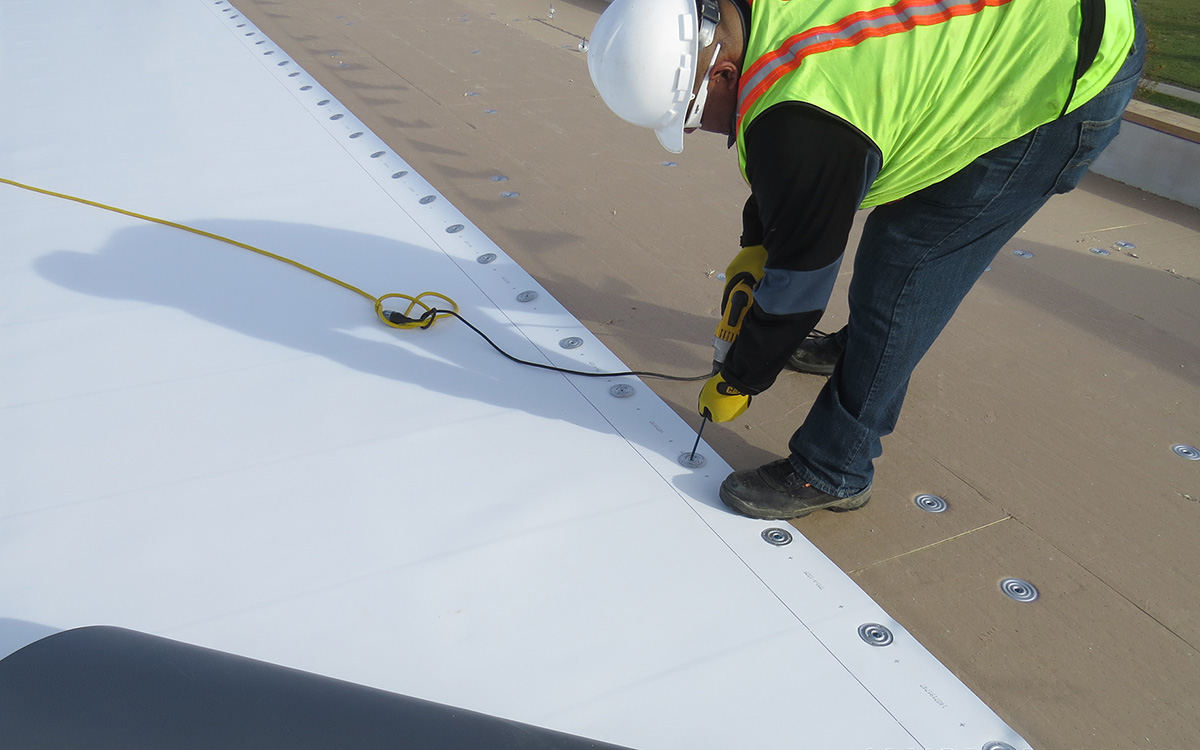
Decades of foot traffic, equipment swaps, and structural creep leave older theater roofs dead flat or ponding in the low spots — and in a Puget Sound climate that standing water is on the roof for much of the year, accelerating membrane aging and loading the deck. Our reroof scopes for multiplexes almost always build in tapered polyisocyanurate to re-establish positive drainage to the drains and scuppers. The most common spec we carry is 60-mil or 80-mil TPO mechanically attached over that tapered iso, with the white surface satisfying the cool-roof energy provisions Washington's commercial code applies to reroof permits, and reinforced walkway pads laid out along the service routes between rooftop units so HVAC crews don't wear through the field.
On the historic and independent houses, we start with a core sample to find out what is actually up there — how many roofing layers, how wet they are, and the total weight-in-place — before recommending a recover versus a full tear-off. Heavy-timber and early-steel decks have load limits that rule out simply adding another layer.
Working Around The Show Schedule
Cinemas run from the afternoon matinee to the last late-night screening, seven days a week, so the operating profile resembles a 24-hour building more than a 9-to-5 one. We sequence tear-off and dry-in so every roof section is watertight before evening screenings begin, coordinate any HVAC shutdown windows for curb and penetration work with facilities management, and keep crews and loading clear of the lobby and marquee during evening open. The marquee and entry-canopy connections, where supports penetrate the membrane, are a notorious chronic leak source on older theaters — we treat each as its own flashing item and re-detail it as part of the project rather than chasing it later.
Movie Theater Roofing Questions
What membrane do you specify for a multiplex?
Most often 60-mil or 80-mil TPO mechanically attached over tapered polyiso. The tapered insulation corrects the ponding these flat roofs develop over decades, the white TPO satisfies cool-roof energy code on reroof permits, and reinforced walkway pads protect the field along the routes HVAC crews travel between units.
How do you handle the long clear-span auditorium decks?
We verify deck type, rib depth, and gauge before specifying attachment, because older short-rib steel deck has far lower fastener pull-out values than modern three-inch deck. Where deflection over a long span is a concern, we may move to an adhered or hybrid system to keep concentrated point loads off the seams.
Does the roof affect acoustics?
Yes. Deck mass and insulation contribute to controlling rain noise and sound bleed between auditoriums, and rooftop equipment set without isolation transmits vibration into the room below. We coordinate curb placement, isolation, and insulation buildup with the acoustic performance of the space.
Can the work be done without closing the theater?
Yes. We plan around the screening schedule, sequence tear-off and dry-in so each section is watertight before evening shows, and coordinate any HVAC shutdowns required for curb work with facilities management.
Do you re-detail the marquee and entry canopy?
Yes. The points where marquee and canopy supports penetrate the membrane are treated as individual flashing items. These transitions are the most common chronic leak on older theaters and rarely get solved by replacing the field membrane alone, so we re-flash them as defined scope.